
Gutter replacement does not automatically mean replacing every downpipe, fascia and soffit. You can often retain serviceable parts, provided the new gutters connect correctly, have adequate support and carry rainwater through to a suitable discharge point. The useful question is which components can remain without compromising the new installation.
Before accepting a quote, ask the installer to separate the proposed gutter work from any downpipe or roofline renewal. That makes it easier to compare a limited replacement with a larger job, and to understand what would justify the extra work.
What does gutter replacement include?
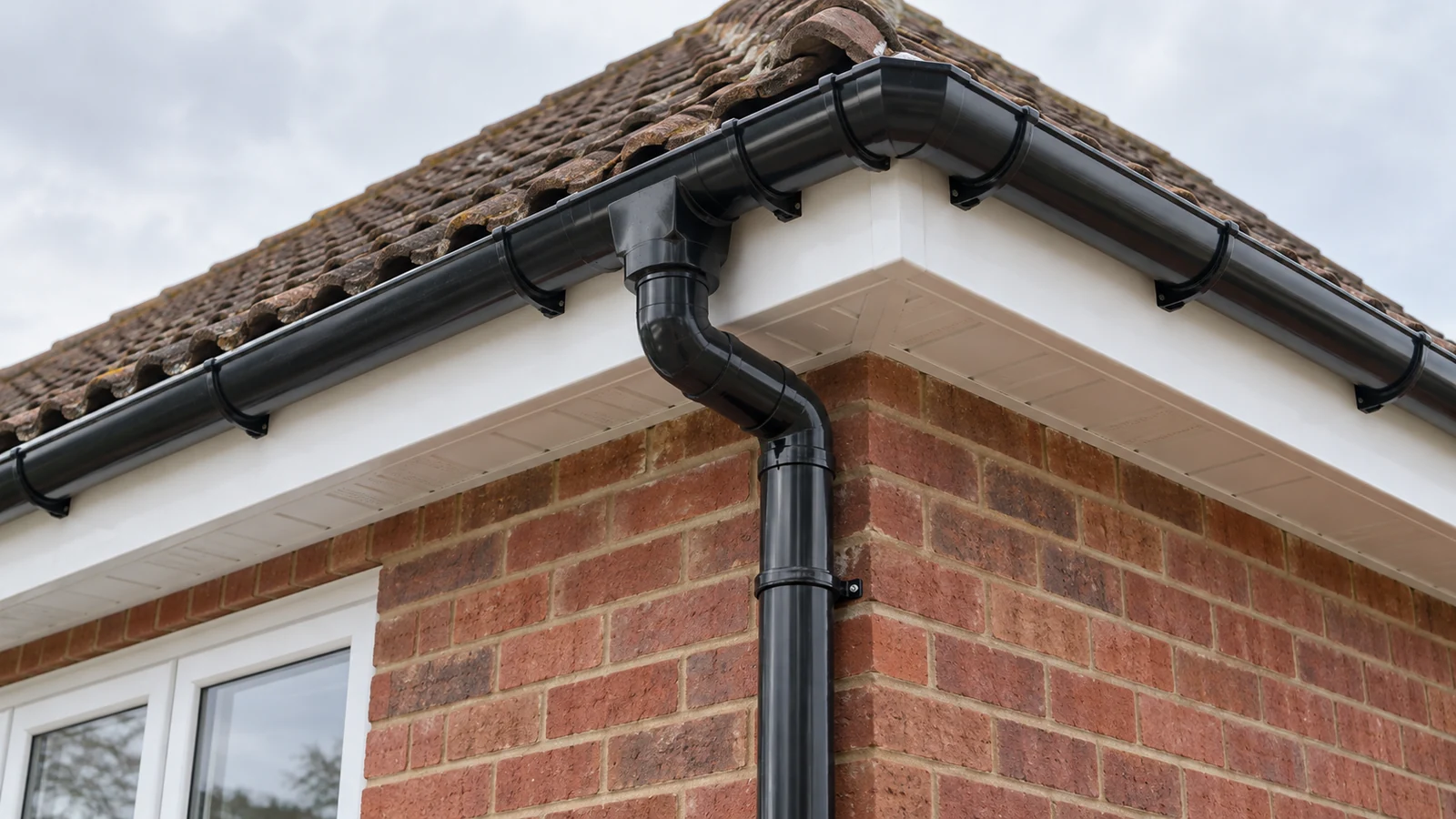
The gutter is the channel along the roof edge. An outlet connects it to a downpipe, often through angled sections called offsets. The fascia is the board behind the gutter; the soffit closes the underside of the eaves. They work together, but they are separate components.
A quote described as “new guttering” might cover only the channels and fittings along one elevation. Another might include downpipes, new brackets and disposal of the old system. Neither description tells you whether the supporting boards will be repaired or replaced.
| Proposed work | When it may suit | What to clarify |
|---|---|---|
| Gutters and associated fittings | Downpipes and supporting boards remain serviceable | Which outlets, brackets and connecting pieces are new? |
| Gutters and downpipes | Pipes are damaged, incompatible or unsuitable for the proposed layout | Where will each pipe discharge, and are lower connections included? |
| Full roofline renewal | Inspection identifies problems with the boards or their support as well | Are boards being removed and replaced, or covered over? |
Ask the contractor to mark the affected elevations on photographs or a simple sketch. “Front and rear gutters, retaining both side downpipes” is a more useful starting point than “replace guttering throughout”.
Can you keep the existing downpipes?
Possibly, but a pipe that looks tidy from the garden still needs checking. Ask the specialist to assess its condition, fixings, joints and route, then confirm that it suits the new gutter outlet. A colour match alone does not establish compatibility.
Check the connection and capacity together
The installer should identify the new gutter system and the proposed connection to the retained pipe. If an adaptor is needed, ask which fitting will be used. The proposal should explain any change to outlet positions or pipe routing.
A larger gutter is not a complete drainage design. Ask whether the roof area, outlet arrangement and existing downpipes have been considered together. Brett Martin’s rainwater technical guide covers system capacity, installation and available adaptors; it also sets out support requirements and allowances for temperature movement for its own products. The selected manufacturer’s instructions should guide the installation.
Follow the pipe all the way down
Confirm whether the quote includes checking and clearing the retained downpipe, and inspecting its visible discharge connection. If a gully backs up or underground drainage needs investigation, find out whether that is separate work. Replacing the channel at the roof edge will not, by itself, remedy a restriction farther along the route.
Also mention shared downpipes or a continuous gutter serving an adjoining property. Ask how the contractor will handle the junction and any access arrangements before work starts.
Can you keep the fascias and soffits?
Sound existing boards may be retained if they provide a suitable base for the proposed gutter supports. Ask how the contractor will assess them and what can only be seen after the old gutter is removed. Appearance from ground level cannot settle the condition of concealed timber or fixings.
If the recommendation is full roofline renewal, request the reason: is there damaged timber, an unsuitable fixing surface or another specific defect? Ask for photographs and an explanation of the remedy. Equally, a gutter-only quote should not assume that fresh brackets can be secured to any board without checking it.
Distinguish replacement from capping
Capping means fitting a covering over an existing board. Replacement means removing the specified old board and fitting a new one. Ask the quote to name the approach and explain how the underlying support will be checked. “New white fascia” is too vague to compare fairly.
Where the work affects soffits or eaves details, ask how existing ventilation and the roof-edge drainage arrangement will be maintained. If older soffit boards might be disturbed, read our guide to asbestos soffits before roofline replacement and flag the uncertainty before anyone removes or drills them.
How to compare gutter-only and full roofline quotes
Start with the same scope for each contractor. If one has priced new downpipes and another has retained them, the totals are not directly comparable. Ask for a core proposal and separately priced options where either approach could work.
- Materials: gutter material, profile, manufacturer or system, colour and proposed fittings.
- Extent: elevations and approximate lengths, plus the number and positions of outlets and downpipes.
- Retained parts: what stays, what checks are included and what limitations apply to it.
- Supporting work: board repairs, new brackets and any affected roof-edge details.
- Access: equipment, protection for conservatories or extensions, and any arrangements needed on neighbouring land.
- Price: the total payable, VAT where applicable, waste removal and any survey charge.
- Aftercare: checks at completion, written warranty terms and whom to contact if a leak appears.
Agree how hidden defects will be handled before accepting the quote. A useful arrangement requires the contractor to show the issue, explain the additional work and obtain your agreement to its price before proceeding. Ask how the exposed area would be protected while you decide.
For example, consider a house with failed rear gutters but apparently sound downpipes. One proposal could retain and check both pipes; another could replace them. Ask what defect or design requirement supports the second option, and what risk or warranty limitation comes with the first. This is an illustrative decision, not a diagnosis of your home.
If you are considering a change of material, our seamless aluminium guttering guide explains another option to discuss. Keep the required work consistent when comparing materials.
How to prepare a gutter replacement enquiry
You need a phone or notebook, a safe ground-level viewpoint and any existing installation or repair records. This is preparation for a professional survey; it does not require ladders, opening fittings or testing the system yourself.
- Record the affected elevation. Photograph the whole front, rear or side of the property from a safe position, including the downpipe route.
- Describe what you have observed. Note where water escapes, whether it happens in ordinary rain or downpours, and any repeated repairs. Record observations without deciding the cause.
- State what you would prefer to retain. List the downpipes, fascias or soffits you hope to keep, subject to the specialist’s inspection.
- Explain access constraints. Mention extensions, conservatories, narrow passages, sloping ground and shared gutters or pipes.
- Request a defined proposal. Ask for retained and replaced components, access, checks, exclusions and the process for approving additional work in writing.
Keep clear of loose overhead components. HSE’s guidance on working at height says to do as much work as possible from the ground and select suitable equipment for work above it. Let the contractor plan access rather than climbing to provide close-up photographs.
What should you check before signing off?
Ask the installer to show what was replaced and what was retained, using photographs for areas you cannot safely see. Request confirmation that the agreed flow and leak checks were completed, including connections to existing pipes. A controlled water check is useful evidence, but does not reproduce every storm condition.
Keep the system details, invoice, warranty terms and any photographs of hidden repairs together. Clarify whether the workmanship warranty covers connections to retained parts and which existing components fall outside it.
For older buildings, Historic England’s rainwater maintenance guidance recommends assessing performance during and after extreme weather and recording inspections and repairs. It also explains why some concealed gutters need closer professional inspection. After installation, note any recurring overflow or leaks from a safe position and report them promptly.
Frequently asked questions
Can new gutters connect to an old downpipe?
Sometimes. The installer must confirm that the pipe is serviceable, suitable for the proposed flow and compatible with the new outlet or an appropriate adaptor. Ask for the connection to be specified in the quote.
Does gutter replacement always require new fascia boards?
No. Existing boards may remain if inspection confirms that they and their supporting structure are suitable for the new installation. Ask what can be assessed before removal and how concealed defects will be handled.
Can I replace just one side of the house?
A limited replacement may be practical where the rest of the system is serviceable. The contractor should explain how the new work joins retained sections and whether shared drainage affects the proposal.
Should I choose deeper gutters if the old ones overflow?
Only after the cause has been assessed. Ask the specialist to check the whole rainwater route and the capacity of the proposed arrangement before recommending a different gutter profile.
Will the new gutter warranty cover old downpipes?
Do not assume it will. Obtain written terms identifying the new work, retained components and connection points, together with any exclusions and the procedure for reporting a fault.
Get a quote that names what stays and what changes
Prepare your observations, then use My Guttering Prices to enquire with guttering replacement specialists. It is a referral service connecting homeowners with independent businesses. Ask responding firms to inspect the relevant components and explain the proposed scope before you choose between a targeted gutter replacement and wider roofline work.
Featured image: AI-generated illustration of a gutter and downpipe connection on a British house; not an actual contractor project.