
Asphalt Driveway Installation Quotes
We can arrange for up to 4 local tradesmen to contact you with free, no-obligation quotes
* Required fields.
An asphalt driveway can be a practical choice for UK homeowners who want a strong, tidy and relatively low-maintenance surface without paying the higher prices often associated with block paving or resin.
You may also hear contractors describe this type of surface as tarmac. In everyday use, the terms are often used interchangeably, although most modern residential driveway surfacing is technically asphalt made from aggregate bound together with bitumen.
As a broad 2026 UK guide, a newly installed asphalt or tarmac-style driveway costs around £80 to £100 per m², with approximately £90 per m² being a useful average for a straightforward installation including labour. A typical 50m² two-car driveway may therefore cost around £4,500, while a small 20m² driveway may cost around £2,200.
However, the surface material is only part of the quote. Excavation, sub-base preparation, drainage, edging and disposal of the old driveway can make a major difference to the final price.
This guide explains typical asphalt driveway costs, resurfacing versus full replacement, drainage, edging, maintenance and what homeowners should compare when requesting quotes.
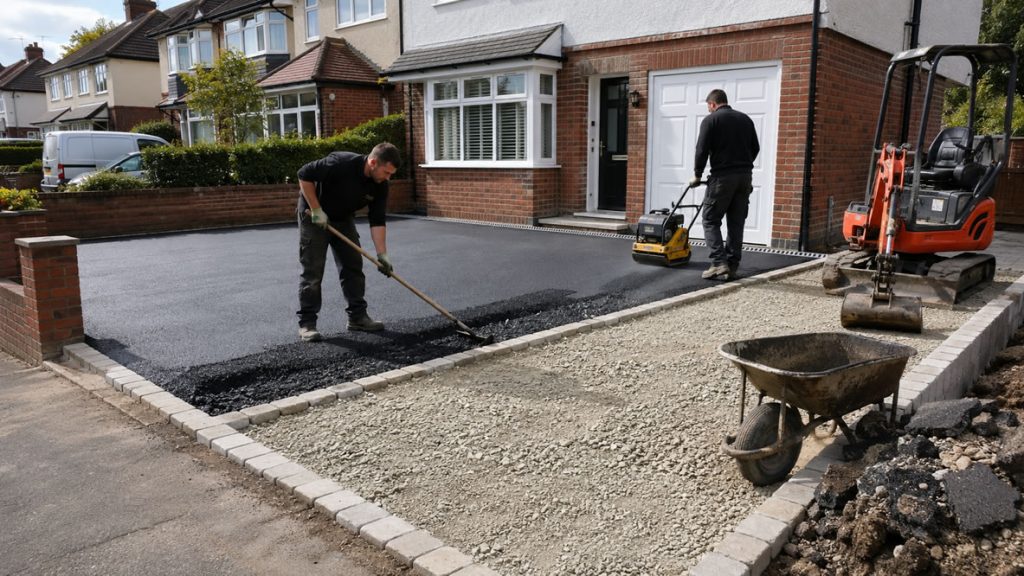
How much does an asphalt driveway cost?
Typical current UK costs look like this:
| Asphalt Driveway | Typical Guide Price |
|---|---|
| New asphalt driveway | £80–£100 per m² |
| Useful average installed cost | Around £90 per m² |
| 20m² single-car driveway | Around £2,200 |
| 50m² two-car driveway | Around £4,500 |
| 100m² large driveway | Around £7,000 |
| Excavation and disposal | Around £28 per m² |
| New sub-base | Around £23 per m² |
| Asphalt material | Around £50 per m² |
These figures are best treated as a starting point rather than a fixed price. Current UK cost guides put a typical 50m² installation at about £4,500, although ground conditions, access and drainage can move the price considerably.
Asphalt driveway prices by size
Larger driveways usually cost more overall, although the price per square metre can sometimes fall slightly because machinery and labour are used more efficiently.
| Driveway Size | Typical Use | Approximate Cost |
| 15–20m² | Small single-car driveway | £1,800–£2,500 |
| 25–35m² | Large single-car driveway | £2,500–£3,500 |
| 40–50m² | Two-car driveway | £3,600–£4,800 |
| 60–80m² | Large two-car driveway | £4,800–£6,500 |
| 100m² | Multi-car driveway | Around £7,000+ |
Very small driveways may have a relatively high cost per square metre because contractors still need to bring machinery, materials and a surfacing team to site.
Asphalt or tarmac: what is the difference?
Homeowners often use the words asphalt and tarmac to describe the same black driveway surface.
Technically, traditional tarmac uses tar as the binder, while modern asphalt uses bitumen.
Modern road and driveway surfacing in the UK generally uses asphalt-type materials rather than traditional coal-tar tarmac.
However, contractors and homeowners still commonly say:
- tarmac driveway
- tarmac drive
- asphalt driveway
- blacktop driveway
when referring to broadly similar surfacing.
Therefore, do not worry too much about the terminology when requesting quotes. Instead, ask the contractor exactly what material and layer specification they intend to install.
What does an asphalt driveway installation involve?
A completely new driveway usually requires several stages.
1. Removing the old surface
The contractor may remove:
- old paving
- concrete
- gravel
- grass
- soil
- failed asphalt
The amount of excavation depends on the existing ground and desired finished level.
2. Excavation
The ground is excavated deeply enough to allow for:
- sub-base
- asphalt base layers
- final surface course
Excavation and disposal currently average around £28 per m² in UK cost guides.
3. Installing the sub-base
A strong driveway needs a compacted foundation.
A suitable granular sub-base is laid and compacted using mechanical equipment.
Current guide costs put this at around £23 per m².
4. Installing edging
Asphalt needs strong edge restraint.
Common options include:
- concrete kerbs
- block paving
- brick edging
- stone setts
The edging holds the asphalt in place and creates a cleaner-looking boundary.
5. Laying the asphalt
The contractor lays and compacts the asphalt while it is hot.
Larger areas may use mechanical surfacing equipment, while smaller residential drives often need more manual work.
6. Rolling and compacting
Proper compaction is essential.
The contractor uses suitable rollers or compactors to create a smooth, strong surface.
7. Allowing the surface to settle
The driveway should be left for the period recommended by the installer before regular vehicle use.
Why is the sub-base so important?
An asphalt driveway is only as strong as the foundation underneath it.
A poor sub-base can lead to:
- sinking
- wheel ruts
- cracks
- depressions
- puddles
- broken edges
This is why a cheap quote that only focuses on the black surface can be misleading.
For a completely new driveway, ask exactly:
- how deep the excavation will be
- what sub-base material will be used
- how thick the compacted layer will be
- how it will be compacted
Spending money on good groundwork is usually better value than choosing a thicker decorative surface over a weak foundation.
Full asphalt replacement or resurfacing?
Not every old driveway needs digging out.
If the existing foundation remains strong, a contractor may be able to resurface it.
This means laying a new asphalt layer over the existing surface after suitable preparation.
When can an asphalt driveway be resurfaced?
Resurfacing can work when:
- the existing driveway remains reasonably level
- the foundation is stable
- cracking is mainly superficial
- there are no major sunken areas
- drainage still works
- the old surface has not broken apart
Because excavation and a new sub-base may not be necessary, resurfacing can cost considerably less than complete replacement.
When is full replacement better?
Full replacement makes more sense when:
- the driveway has sunk badly
- wheel ruts keep forming
- large cracks return after repair
- several areas move under vehicle weight
- drainage is poor
- the foundation was badly built
- levels need changing
- the driveway is being widened
Putting fresh asphalt over a failed base may make the driveway look better temporarily, but the underlying movement can soon damage the new surface.
Asphalt driveway resurfacing costs
If the existing base remains suitable, the main cost comes from preparing and laying the new surface course.
Current UK guidance puts asphalt/tarmac material at around £50 per m², with resurfacing labour often around £150 to £200 per person per day.
A broad guide might therefore look like:
| Resurfacing Job | Typical Guide Cost |
| Small driveway | £1,000–£2,000+ |
| 40–50m² driveway | £2,000–£3,500+ |
| Large driveway | £3,000–£5,000+ |
| Localised repair | £150–£500+ |
The exact cost depends on how much preparation the existing surface needs.
Can asphalt be laid over concrete?
Sometimes.
A sound concrete driveway can potentially act as a base for asphalt.
However, the contractor needs to inspect:
- cracks
- movement
- levels
- drainage
- joints
- edge condition
Cracks in the concrete can sometimes reflect through the asphalt above.
Therefore, laying asphalt directly over badly cracked concrete may not provide a long-lasting solution.
Can asphalt be laid over old block paving?
Usually, lifting the blocks and preparing the foundation properly is preferable.
Block paving can move independently, which creates a poor base for asphalt unless significant preparation takes place.
If the existing block base remains excellent, a contractor may be able to reuse parts of the foundation after removing the blocks.
How thick should an asphalt driveway be?
There is no single thickness for every driveway.
A proper system can include more than one asphalt layer, such as:
- base course
- binder course
- surface course
The specification depends on:
- expected vehicle weight
- ground conditions
- existing foundation
- driveway use
A household driveway used by normal cars does not need the same construction as a commercial yard carrying heavy vans.
However, avoid quotations that propose an extremely thin cosmetic layer over poor ground.
Asphalt driveway edging
Edging plays both a practical and decorative role.
Without good edge restraint, asphalt can:
- crumble
- spread
- crack
- break away under vehicle tyres
Popular edging options include:
Block paving borders
These are very common.
They create an attractive contrast between black asphalt and coloured paving.
Concrete kerbs
Strong and practical, particularly around larger driveways.
Natural stone setts
A more premium option.
They work particularly well on traditional homes.
Brick edging
Useful where homeowners want the driveway to tie in with the brickwork of the house.
How much does driveway edging cost?
The cost depends on the product and amount of cutting.
A simple concrete edge may add only a modest amount.
Decorative block or natural stone borders can add several hundred pounds or more to the project.
For example, a contractor may use a block-paved border around:
- the entire driveway
- entrance
- flower beds
- drainage channels
This can make a basic asphalt surface look considerably more attractive.
Asphalt driveway drainage
Driveway drainage needs to be planned before surfacing begins.
Asphalt is normally an impermeable surface. Therefore, rainwater needs somewhere suitable to go.
Possible solutions include:
- linear channel drains
- soakaways
- drainage towards planted areas
- permeable sections
- drainage gullies
The driveway should not simply slope towards the house.
Do I need planning permission for an asphalt driveway?
Front-garden driveway rules are particularly important because standard asphalt does not normally allow water to soak through it.
Where a new or replacement front driveway larger than 5m² uses an impermeable surface, planning requirements can apply unless the water drains to a permeable area within the property, such as a lawn or soakaway.
Therefore, drainage should form part of the initial driveway design.
Your contractor should be able to explain how they intend to deal with rainwater.
What about a dropped kerb?
If vehicles cross a public pavement to reach your driveway, you normally need an approved vehicle crossover or dropped kerb.
The local highway authority controls this work.
Creating a new parking space in the front garden does not automatically give you permission to drive across the pavement.
A dropped kerb can add a substantial extra cost to a new driveway project, so investigate it before committing to the surfacing work.
Asphalt for small driveways
Asphalt can work very well on small driveways.
It is especially practical where:
- space is limited
- you need one parking bay
- the existing front garden is simple
- you want a low-maintenance finish
However, the price per square metre can be higher on very small jobs because the surfacing team still needs to bring:
- hot asphalt
- compaction equipment
- tools
- labour
Adding a block-paving border can help a small black driveway look more deliberate and attractive.
Asphalt for large driveways
Asphalt becomes especially cost-effective on larger areas.
It is commonly used for:
- long driveways
- large detached houses
- multiple parking bays
- shared access areas
- turning areas
Compared with laying thousands of individual blocks, asphalt can cover a large area relatively quickly.
This is one reason its cost per square metre becomes competitive on bigger projects.
How long does an asphalt driveway take to install?
A small driveway may take around 2 to 4 working days.
A larger project may take 4 to 7 days or more.
Typical stages include:
| Work | Typical Time |
| Excavation | 1–2 days |
| Sub-base preparation | 1 day |
| Edging and drainage | 1–2 days |
| Asphalt surfacing | Usually 1 day |
| Final finishing | Same day or following day |
Bad weather, difficult access or extensive drainage work can increase the timescale.
How long before you can park on new asphalt?
Follow the installer’s advice.
Although asphalt becomes firm relatively quickly, it continues to settle and harden after installation.
Light foot traffic may be possible fairly soon, but vehicles should normally stay off the surface until the installer confirms that it is ready.
During very hot weather, fresh asphalt can also soften slightly.
Avoid:
- turning steering wheels while stationary
- leaving heavy point loads
- using motorcycle stands without protection
- parking extremely heavy vehicles repeatedly
while the surface is still young.
How long does an asphalt driveway last?
A properly installed asphalt driveway can commonly last around 10 to 20 years, while particularly good installations may last longer with suitable maintenance.
Lifespan depends on:
- sub-base quality
- asphalt specification
- traffic
- drainage
- installation quality
- weather
- maintenance
Again, foundation quality makes a major difference.
What maintenance does asphalt need?
Asphalt needs relatively little maintenance compared with many individual paving systems.
Useful maintenance includes:
- sweeping debris
- removing weeds from edges
- cleaning oil spills
- repairing cracks early
- maintaining drainage channels
- checking broken edges
Small cracks are much cheaper to deal with before water reaches the foundation.
Why do asphalt driveways crack?
Cracking can happen because of:
- ground movement
- weak sub-base
- tree roots
- freeze-thaw cycles
- poor drainage
- heavy vehicles
- ageing
- badly repaired trenches
A few small cracks do not automatically mean the entire driveway needs replacing.
However, widespread cracking combined with sinking normally points to a deeper problem.
Asphalt driveway pothole repairs
Potholes often form where water penetrates the surface and weakens the layers beneath.
A proper repair normally involves:
- cutting back loose material
- cleaning the damaged area
- repairing the foundation if necessary
- filling with suitable asphalt
- compacting the patch
Simply filling the top of a deep pothole may only provide a temporary repair.
How much do asphalt driveway repairs cost?
Broad guide prices might include:
| Repair | Typical Cost |
| Small crack repairs | £100–£250+ |
| Small pothole | £150–£300+ |
| Several local repairs | £250–£600+ |
| Edge repairs | £200–£500+ |
| Larger patch | £300–£800+ |
| Resurfacing | Often £40–£70+ per m² depending on preparation |
Minimum call-out charges can make tiny repairs relatively expensive.
Asphalt vs block paving
Both are popular, but they suit different priorities.
| Feature | Asphalt | Block Paving |
| Typical installed cost | Around £90/m² | Around £100/m² |
| Installation speed | Faster | Slower |
| Design choice | Limited | Excellent |
| Maintenance | Low | Moderate |
| Weed growth | Low | More likely in joints |
| Individual repairability | Moderate | Excellent |
| Large driveways | Excellent | Good |
| Traditional appearance | Moderate | Excellent |
Current UK pricing puts asphalt/tarmac around £90 per m² compared with roughly £100 per m² for block paving.
Asphalt vs resin driveway
Resin usually costs more.
Current guide prices put resin-bound driveways around £120 per m², compared with around £90 per m² for asphalt/tarmac.
Choose asphalt when:
- cost matters
- the driveway is large
- you want a simple surface
- quick installation matters
- low maintenance matters
Choose resin when:
- appearance matters more
- you want decorative aggregates
- you prefer a smoother premium finish
- a properly designed permeable surface is important
Asphalt vs gravel
Gravel costs less initially.
Current average installed costs place gravel around £60 per m² compared with approximately £90 per m² for asphalt.
However, asphalt offers:
- a firmer surface
- less stone movement
- easier walking
- easier use for wheelchairs and pushchairs
- less regular raking
Gravel remains attractive where drainage and low upfront cost matter most.
Asphalt vs concrete
The average installed cost is fairly close.
Current guides put standard concrete around £95 per m² and asphalt/tarmac around £90 per m².
Concrete offers a hard rigid surface.
Asphalt is slightly flexible, which can help it cope with modest ground movement.
Concrete also takes longer to cure before regular use.
Can asphalt driveways be decorative?
Yes, although the options are more limited than block paving.
Ways to improve the appearance include:
- block-paved borders
- stone setts
- contrasting entrance aprons
- decorative drainage channels
- planted edges
- shaped driveway boundaries
A simple black asphalt centre surrounded by a contrasting block border is particularly popular.
What affects asphalt driveway quotes?
Driveway size
More area means more material, although larger areas may achieve a lower unit cost.
Existing surface
Removing thick reinforced concrete costs more than removing gravel or turf.
Ground condition
Weak or wet soil may need deeper excavation.
Sub-base
A completely new foundation adds cost but improves durability.
Drainage
Channels, gullies and soakaways increase the price.
Edging
Decorative kerbs and block borders add labour.
Access
Narrow access makes excavation and material delivery harder.
Shape
Curves and complicated boundaries need more hand work.
Slopes
Steep driveways can require additional preparation and drainage.
Waste disposal
Old concrete, soil and paving need taking away.
Labour costs
Current 2026 guidance suggests around £150–£200 per person per day for driveway resurfacing work, with a two-person team averaging approximately £400 per day.
However, most asphalt driveway contractors provide a complete project price instead of charging homeowners by the day.
The fixed quote should normally include:
- labour
- plant
- materials
- compaction
- surfacing
unless stated otherwise.
Mini digger and skip costs
Excavation may require a mini digger.
Current guide prices put mini-digger hire at around £250 per day, while a skip can cost around £165 for a typical weekend hire, although regional prices vary.
Larger driveway projects may use grab lorries instead because they can remove large amounts of spoil quickly.
What should an asphalt driveway quote include?
Check for:
| Quote Item | What to Ask |
| Excavation | What depth? |
| Disposal | Is all spoil removed? |
| Sub-base | Material and compacted depth? |
| Edging | Which product? |
| Drainage | How will rainwater be managed? |
| Asphalt | What specification and thickness? |
| Compaction | What equipment will be used? |
| Manholes | Are adjustments included? |
| Labour | Fully included? |
| Machinery | Included? |
| VAT | Included or extra? |
| Guarantee | What does it cover? |
A detailed specification makes it much easier to compare quotes properly.
Common asphalt driveway installation mistakes
Installing over a weak base
The new surface may quickly crack or sink.
Poor drainage
Standing water shortens the life of the driveway.
Weak edges
Unsupported asphalt can crumble.
Making the surface too thin
A thin cosmetic layer is not a substitute for proper construction.
Ignoring levels near the house
The finished driveway should not create water problems around walls and thresholds.
Choosing the cheapest quote without comparing groundwork
Two quotes may use completely different sub-base depths.
Should you choose the cheapest asphalt driveway quote?
Not necessarily.
A contractor can reduce the price by:
- excavating less
- using less sub-base
- reducing asphalt thickness
- avoiding proper drainage
- skipping strong edging
Some of those savings may be invisible when the driveway is first completed.
Problems can appear months or years later.
Therefore, compare the proposed construction method as carefully as the price.
Questions to ask an asphalt driveway contractor
Before accepting a quote, ask:
- Is this a full replacement or resurfacing?
- How deep will you excavate?
- What sub-base will you install?
- How will you compact it?
- What asphalt specification will you use?
- How thick will each layer be?
- What edging is included?
- How will rainwater drain?
- Are manhole adjustments included?
- Is all waste removal included?
- Do I need a dropped kerb?
- When can I drive on the finished surface?
- What guarantee do you provide?
An experienced contractor should be able to explain the complete build-up.
Get asphalt driveway quotes
Asphalt can provide a strong, simple and cost-effective driveway for many UK properties.
A straightforward new installation currently costs around £90 per m² on average, which puts a typical two-car 50m² driveway at approximately £4,500. However, excavation, drainage, edging and site access can change the final price considerably.
If the existing foundation remains strong, resurfacing may cost considerably less than digging everything out and starting again.
The best way to compare contractors is to look beyond the finished black surface and check exactly how each company proposes to prepare the ground underneath.
Use the quotation form on this page to compare asphalt driveway quotes from local driveway installation and resurfacing specialists.
Frequently Asked Questions
How much does an asphalt driveway cost in the UK?
A professionally installed asphalt or tarmac-style driveway currently costs around £80 to £100 per m², with approximately £90 per m² being a useful average.
How much does a 50m² asphalt driveway cost?
A typical 50m² two-car asphalt driveway costs around £4,500, although drainage, excavation and access can increase the price.
How much does a small asphalt driveway cost?
A 20m² single-car driveway may cost around £2,200 for a full installation.
Is asphalt cheaper than block paving?
Usually, yes. Current averages put asphalt or tarmac around £90 per m² compared with roughly £100 per m² for standard block paving.
Is asphalt cheaper than resin?
Yes. Resin-bound driveways commonly average around £120 per m², compared with approximately £90 per m² for asphalt.
Can you resurface an old asphalt driveway?
Yes, if the existing base remains sound. A new surface layer can sometimes be installed without replacing the entire foundation.
When should an asphalt driveway be completely replaced?
Full replacement is usually better when the driveway has widespread sinking, deep cracks, poor drainage or a failed sub-base.
How long does an asphalt driveway last?
A properly installed asphalt driveway can commonly last around 10 to 20 years, while good installations may last longer with suitable maintenance.
Does an asphalt driveway need drainage?
Yes. Standard asphalt is impermeable, so rainwater needs to be directed towards suitable drainage or a permeable area.
Do I need planning permission for an asphalt driveway?
Planning requirements can apply to impermeable front-garden driveways larger than 5m² unless surface water drains to a suitable permeable area within the property.
How long does asphalt driveway installation take?
A small driveway may take around two to four working days, while larger and more complicated installations may take a week or more.
Should I get several asphalt driveway quotes?
Yes. Compare excavation, sub-base depth, asphalt specification, drainage, edging and disposal as well as the total price.