
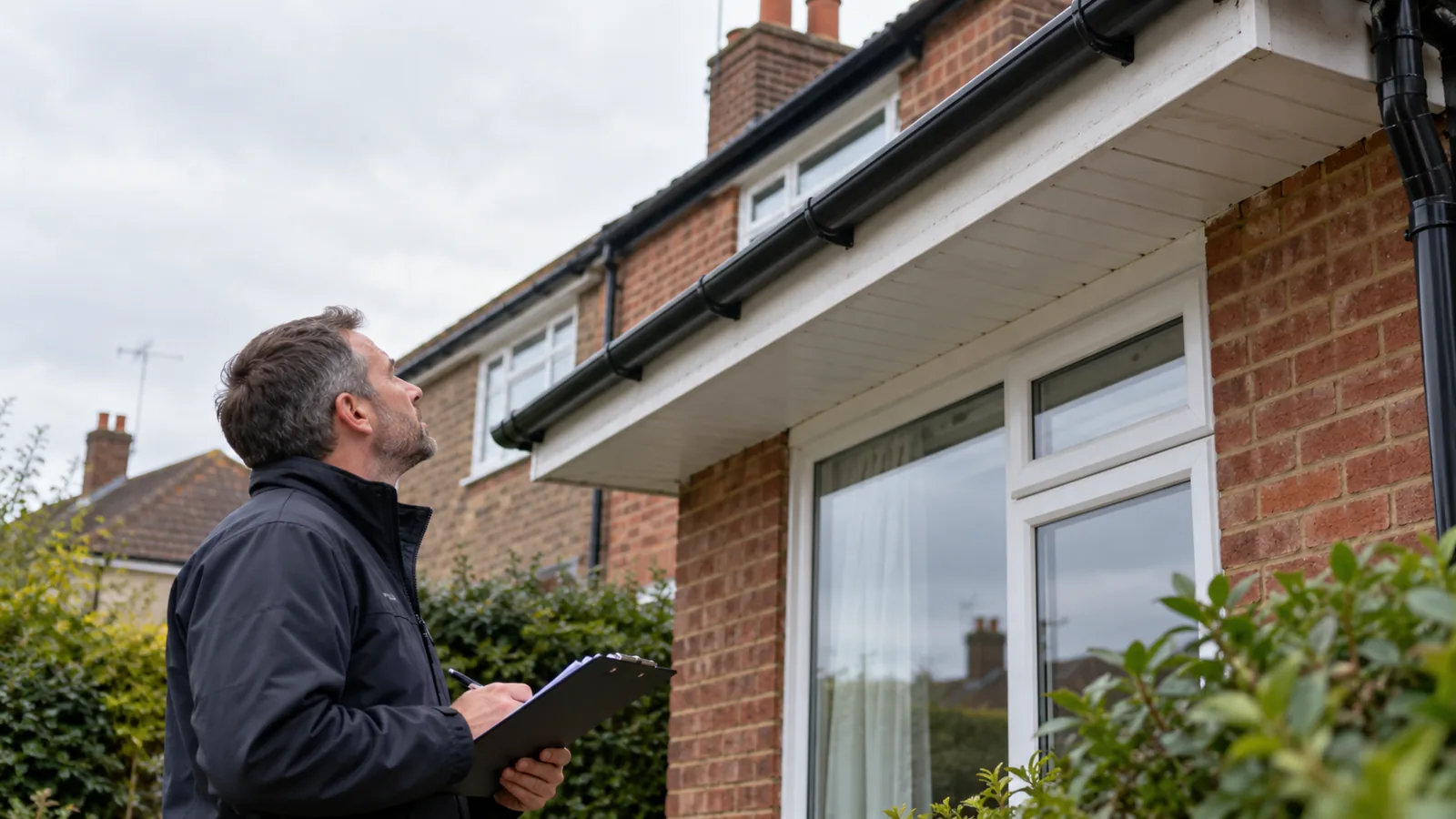
If you are replacing old gutters, fascias or soffits, identify any suspect soffit boards before a contractor removes, drills or fixes through them. Some older roofline boards contain asbestos cement; others may be asbestos insulating board (AIB), which needs a different assessment and controls. A photograph or the age of the house cannot confirm the material. Pause work in the affected area, tell the roofline installer what you know, and arrange competent assessment and sampling where needed.
This guide is for UK homeowners planning roofline work. It explains how to establish the scope and compare contractors, not how to handle asbestos yourself. The HSE sources below govern Great Britain; for a property in Northern Ireland, check the relevant local regulator’s requirements. Guidance checked on 4 October 2026.
Why soffits need checking before work starts
Soffits are the boards beneath the eaves. Replacing a gutter or fascia can involve disturbing the soffit edge, fixings or adjacent panels even if the soffit is not on the initial shopping list. HSE identifies both asbestos cement and AIB in roofline locations. The distinction matters: AIB is generally a higher-risk material, and work on it is often licensable. Do not ask a general roofline installer to remove an unidentified board as an incidental extra.
Asbestos in good condition and unlikely to be disturbed can often remain in place and be monitored. Planned roofline work changes the question: will the proposed fixings, access or removal disturb the board? HSE’s advice on asbestos in homes explains when leaving material in place may be appropriate and says to inform contractors about known asbestos before work begins.
How to establish what the boards are
Tell a competent asbestos surveyor exactly which parts of the roofline will be changed. Ask whether targeted sampling will answer the question or whether the wider work area needs a refurbishment survey. The report should identify which boards were inspected, their location and condition, which samples were analysed, and any areas that could not be accessed. A result for one board should not silently be treated as proof about every section of a roofline.
Only laboratory analysis of a representative sample can confirm asbestos in a suspect material. Sampling should be undertaken by a suitably trained person and analysed by an accredited laboratory, as set out in HSE’s survey and analysis guidance. Do not break a corner off a board yourself to check it.
Local Pros has a separate asbestos survey and testing guide if you need to decide what to ask a surveyor before pricing the roofline work.
Decide whether to retain or remove the soffits
Once the material has been identified, ask the asbestos specialist and roofline installer to agree a workable sequence. A sound board might be left undisturbed if the design and access genuinely allow it. Removal may be needed if it is damaged, will be disturbed by the new work or cannot safely be retained. Do not accept a vague promise to “cap over” suspect boards without knowing how the new components will be fixed and how the existing material will be managed later.
The asbestos contractor should classify the specific job and explain whether it is licensed, notifiable non-licensed or non-licensed work. That decision depends on the material, condition and planned method, not simply on the word “soffit”. HSE’s material and location guide distinguishes asbestos cement from AIB and indicates where trained or licensed specialists are needed. Check that the proposed contractor has the appropriate competence and, where required, the licence.
What to compare in asbestos soffit removal quotes
Once the survey or test result is available, seek written asbestos removal quotes against the same scope. My Asbestos Quotes connects enquiries with independent local specialists, subject to availability. Compare what each company will actually do, not only the total.
Ask each bidder to state:
- What is included: the elevations, approximate length or number of boards, fascias and any other suspect material.
- What evidence they used: the survey or sample results and how any untested sections will be handled.
- How the work is classified: whether a licence or notification is required and who is responsible for it.
- Access and protection: scaffolding or other access, protection of windows and garden areas, and arrangements for occupants.
- Waste and handover: packaging, lawful disposal, cleaning and the records or clearance evidence appropriate to the work.
- Commercial terms: VAT, likely dates, exclusions and how unexpected material or extra work will be priced and approved.
A cheaper quote may exclude scaffolding, fascia removal or disposal. Ask for those differences in writing. Keep the asbestos scope and the new roofline installation scope clear, even when one company coordinates both. The installer should know when the area can be handed back and who confirms that.
A practical sequence for your roofline project
- Share the proposed work. Mark the elevations and explain whether gutters, fascias, soffits or roof edges will be changed. Tell every contractor about suspect material before they quote.
- Arrange competent identification. Commission an assessment and sampling suited to the work area. Keep the report and pass it to bidders.
- Agree the asbestos plan. Ask the specialist to explain whether material can remain safely in place or needs removal, and how the job is classified.
- Compare matching written scopes. Check access, disposal, handover and VAT as well as price. Resolve exclusions before booking.
- Sequence the trades. Confirm who controls the site, when roofline installation can begin and what documentation each contractor will provide.
Do not start drilling, scraping or removing boards while identification is unresolved. If a board has already broken or debris is present, stop work and keep others away while you seek professional advice.
Frequently asked questions
Are all old soffit boards asbestos?
No. Older roofline boards may be asbestos cement, AIB or asbestos-free products. Appearance alone is unreliable; a competent assessment and analysis of representative samples can confirm a suspect material.
Can new soffits be fitted over existing asbestos boards?
Sometimes a sound board can remain undisturbed, but the entire fixing method and future maintenance need assessing first. Do not assume overcladding is suitable simply because the existing boards look intact.
Does every asbestos soffit removal job need a licensed contractor?
No. The work category depends on the material and method. AIB commonly involves higher-risk controls than asbestos cement. Ask the specialist to explain and document the classification for your particular job.
Should the roofline installer or asbestos specialist go first?
Identification comes first. If removal is required, agree with both contractors who arranges access, when asbestos work finishes and what handover is needed before installation begins.
If you are planning a full roofline update, compare the separate soffits and fascias project guide alongside the asbestos scope so neither quote leaves a gap.