
Air Conditioning Installation Quotes
We can arrange for up to 4 local tradesmen to contact you with free, no-obligation quotes
* Required fields.
Air conditioning used to be unusual in British homes, but that is changing quickly. Hotter summer weather, warmer bedrooms, home working and increasingly well-insulated properties have made fixed air conditioning much more attractive to UK homeowners.
Modern systems can also do more than simply cool a room. Many wall-mounted split systems can provide heating as well, while features such as timers, app control, dehumidification and quiet night modes make them practical throughout much of the year.
The cost depends on how many rooms you want to cool, the size of each room, where the outdoor unit can go and how difficult it is to route the pipework.
As a broad guide, a single-room wall-mounted air conditioning system may cost around £1,600 to £2,300 supplied and installed. Installing air conditioning in several bedrooms or living spaces can cost around £3,500 to £7,500 or more, while larger ducted or whole-house systems can reach £10,000+.
This guide explains typical domestic air conditioning installation costs, the different systems available and what homeowners should compare when requesting air conditioning quotes.
How much does home air conditioning installation cost?
The number of rooms makes a big difference.
| Air Conditioning Project | Typical Installed Cost |
|---|---|
| Small home office split air con system | £1,500–£2,000+ |
| Bedroom air conditioning | £1,600–£2,300+ |
| Larger bedroom or living room | £1,800–£2,800+ |
| Conservatory air conditioning | £1,800–£3,000+ |
| Two-room multi-split system | £3,000–£4,500+ |
| Three-room multi-split system | £4,000–£6,000+ |
| Four-room system | £5,000–£7,500+ |
| Larger multi-room installation | £7,500–£12,000+ |
| Ducted whole-home system | £7,500–£15,000+ |
These are broad guide prices.
A simple bedroom installation with the indoor and outdoor units close together may cost less than a system requiring long refrigerant pipe runs, condensate pumps, scaffolding or extensive electrical work.
What is split air conditioning?
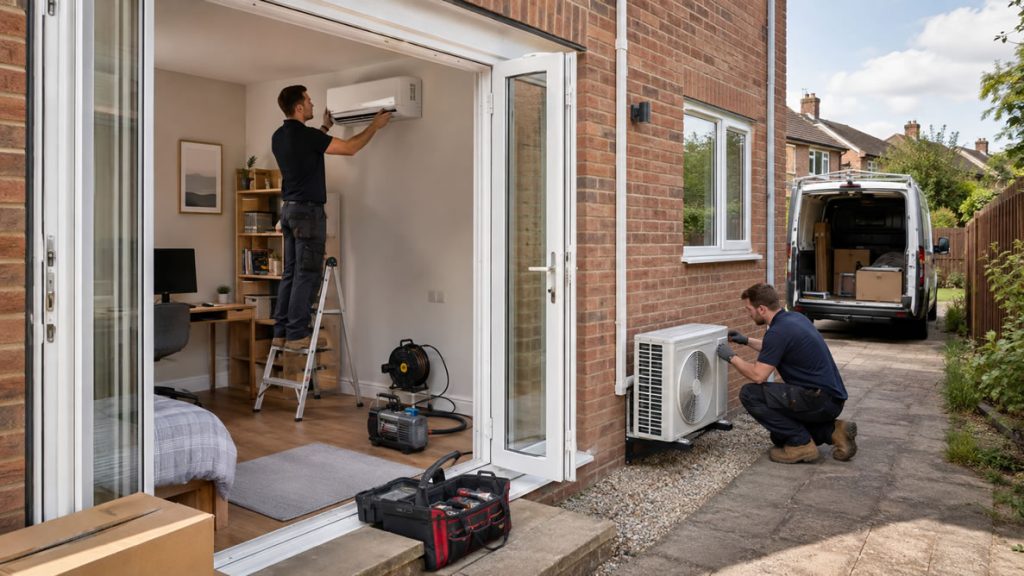
A split air conditioning system has two main parts.
Inside the room is the indoor unit.
Outside the property is the condenser unit.
Small refrigerant pipes and electrical cables connect the two.
The indoor unit cools the room while the outdoor unit releases heat outside.
Most domestic installations use a wall-mounted indoor unit positioned fairly high on the wall.
Why are split systems popular in UK homes?
Split systems work particularly well for retrofitting because they do not normally need large ventilation ducts running throughout the house.
Advantages include:
- powerful cooling
- relatively quiet operation
- good energy efficiency
- heating on many models
- app and remote control
- dehumidification
- relatively discreet installation
- no need for open windows
They are considerably more effective than basic portable air conditioners.
How much does a single split air conditioner cost?
For one room, a typical installed price may sit around £1,600 to £2,300.
The price usually includes:
- indoor wall unit
- outdoor condenser
- refrigerant pipework
- condensate drain
- protective trunking
- mounting brackets
- wiring
- installation labour
- system commissioning
Electrical alterations may sometimes be priced separately.
Ask the installer exactly what the quote covers.
Air conditioning unit prices
The air conditioning equipment itself represents only part of the overall installation price.
Typical equipment-only prices might look like:
| Unit Size | Typical Equipment Cost |
| 9,000 BTU split unit | £550–£800+ |
| 12,000 BTU split unit | £620–£900+ |
| 18,000 BTU split unit | £800–£1,100+ |
| 24,000 BTU split unit | £900–£1,300+ |
Premium brands and higher-efficiency systems can cost considerably more.
Installation labour, pipework and electrical work then need adding.
What size air conditioner do I need?
Air conditioning systems are normally sized according to the amount of cooling a room requires.
Capacity is often shown in BTU or kilowatts.
A rough domestic guide might look like:
| Room | Common System Size |
| Small bedroom | 7,000–9,000 BTU |
| Average bedroom | 9,000–12,000 BTU |
| Large bedroom | 12,000 BTU+ |
| Home office | 9,000–12,000 BTU |
| Living room | 12,000–18,000 BTU |
| Large open-plan space | 18,000–24,000+ BTU |
| Conservatory | Often 12,000–24,000+ BTU |
However, room area alone is not enough to size the system correctly.
An installer should also consider:
- ceiling height
- window area
- orientation
- insulation
- number of occupants
- computers and appliances
- roof construction
- amount of sunlight entering the room
A south-facing conservatory can need much more cooling than a similarly sized shaded bedroom.
Bedroom air conditioning quotes
Bedrooms are one of the most popular places for domestic air conditioning.
Many UK homes become uncomfortable upstairs during summer because heat rises and bedrooms can retain warmth well into the evening.
A typical bedroom installation may cost around £1,600 to £2,300.
Important considerations include:
- noise level
- indoor unit position
- airflow direction
- pipe route
- outdoor unit location
- condensate drainage
The unit should not normally blow cold air directly onto the bed.
Air conditioning for loft conversions
Loft rooms can become particularly hot because they sit directly beneath the roof.
They often have:
- limited roof insulation compared with newer construction
- roof windows
- large areas of sloping ceiling
- strong solar gain
Air conditioning can work very well in these rooms.
However, pipe routing may be more complicated because the indoor unit sits at the highest level of the property.
A loft installation may cost around £1,800 to £3,000+ depending on access.
Home office air conditioning
Home offices are another common location.
Even a relatively small room can become hot because computers, monitors and other electronics generate additional heat.
A typical small office installation may cost around £1,500 to £2,200.
A correctly sized fixed system can provide much quieter cooling than a portable unit, which can be useful during:
- video meetings
- phone calls
- concentrated work
Many systems also provide heating during winter.
Conservatory air conditioning installation
Conservatories can be difficult spaces to keep comfortable.
Large glazed areas allow substantial amounts of solar heat into the room during summer.
At the same time, conservatories can become cold during winter.
For that reason, a reversible air conditioning system that provides both cooling and heating can work particularly well.
Typical installation costs may sit around £1,800 to £3,000 or more.
The system may need a higher capacity than a conventional room of the same floor area.
Living room air conditioning
Living rooms tend to be larger than bedrooms and may have bigger windows or patio doors.
A larger 12,000 to 18,000 BTU system may therefore be required.
A typical installed price could be around £1,800 to £2,800+.
Open-plan kitchens and living spaces can need even larger equipment because:
- the room volume is greater
- cooking creates heat
- large glazing increases solar gain
- more people use the space
What is multi-split air conditioning?
A multi-split system connects several indoor air conditioning units to one outdoor condenser.
For example, one outdoor unit might serve:
- main bedroom
- second bedroom
- home office
Each indoor unit can usually operate independently.
This means you can cool one room without necessarily cooling the others.
Multi-split installation costs
Typical prices may look like:
| System | Typical Installed Price |
| 2 indoor units | £3,000–£4,500+ |
| 3 indoor units | £4,000–£6,000+ |
| 4 indoor units | £5,000–£7,500+ |
| 5 indoor units | £6,500–£9,000+ |
| 6-room system | £7,500–£12,000+ |
The exact cost depends heavily on pipe lengths and installation complexity.
Multi-split or separate single systems?
Both approaches have advantages.
Multi-split advantages
- fewer outdoor units
- cleaner exterior appearance
- several rooms served from one condenser
- independent indoor controls
Multi-split disadvantages
- longer pipe runs
- more complex installation
- one outdoor unit affects several rooms if it fails
- installation may cost more initially
Separate single-split systems can sometimes provide greater flexibility.
A good installer should compare both options.
What is ducted air conditioning?
Ducted systems hide much of the air conditioning equipment above ceilings or within loft spaces.
Instead of having a wall-mounted unit in each room, cooled air enters through discreet ceiling or wall grilles.
This creates a cleaner appearance.
Ducted systems suit:
- larger homes
- new builds
- major renovations
- loft spaces with room for ductwork
- homeowners who prefer hidden equipment
How much does ducted air conditioning cost?
Ducted installations are usually more expensive.
A modest multi-room installation may begin around £7,500, while larger whole-house systems can cost £10,000 to £20,000 or more.
Costs increase because the installer may need:
- ducting
- ceiling units
- grilles
- plenums
- controls
- zoning
- ceiling alterations
- access panels
Ducted systems are generally easiest to install during major refurbishment.
Wall-mounted vs ducted air conditioning
| Feature | Wall-Mounted Split | Ducted |
| Installation cost | Lower | Higher |
| Retrofit suitability | Excellent | More difficult |
| Appearance | Indoor unit visible | Mostly hidden |
| Installation time | Faster | Longer |
| Maintenance access | Easy | More involved |
| Multi-room suitability | Good | Excellent |
| Best for existing houses | Usually | Sometimes |
| Best for major renovation | Good | Excellent |
For most existing UK homes, wall-mounted split systems provide the simplest solution.
Portable or fixed air conditioning?
Portable air conditioners appear cheaper because they do not require professional installation.
A portable unit might cost around £300 to £650.
However, fixed split systems provide several advantages.
| Feature | Portable AC | Split AC |
| Purchase cost | Low | Higher |
| Professional installation | No | Yes |
| Noise | Higher | Lower |
| Efficiency | Lower | Higher |
| Window needs opening | Usually | No |
| Cooling performance | Moderate | Strong |
| Heating function | Sometimes | Common |
| Permanent solution | No | Yes |
Portable units can make sense for renters or occasional use.
For frequent summer cooling, a split system is usually the more effective long-term option.
Can air conditioning also heat the house?
Many modern split systems are effectively air-to-air heat pumps.
They can reverse their refrigeration cycle and provide warm air during cooler weather.
This can be useful for:
- conservatories
- garden offices
- loft conversions
- home offices
- bedrooms
- rooms without central heating
The system can often heat a room quickly.
However, whether it should replace the home’s main heating system depends on the property and system design.
How efficient is modern air conditioning?
Modern inverter systems can be very efficient.
Rather than running at full power continuously, inverter technology allows the compressor to adjust its output according to demand.
Once the room reaches the target temperature, the system can reduce its workload.
Efficiency varies between models, so compare ratings such as:
- SEER for cooling
- SCOP for heating
- energy rating
- seasonal performance
Higher-efficiency units may cost more initially but use less electricity over time.
How much does air conditioning cost to run?
Running costs depend on:
- unit size
- efficiency
- electricity tariff
- outdoor temperature
- thermostat setting
- insulation
- usage time
A small modern unit does not necessarily draw its full rated cooling capacity as electrical power.
For many domestic systems, the actual electrical input while running may be around 0.5 to 2kW, depending on demand.
Therefore, running costs could broadly range from around 10p to 50p per hour in many situations.
Once the room reaches the target temperature, an inverter system can reduce its power consumption substantially.
Does air conditioning need an outdoor unit?
Most fixed split systems do.
The outdoor condenser normally sits:
- on wall brackets
- on a ground-mounted base
- on a flat roof
- on a balcony where permitted
The installer needs to think about:
- noise
- airflow
- maintenance access
- neighbouring properties
- appearance
- pipe distance
Outdoor unit positioning can have a significant effect on the installation quote.
Where can the indoor unit go?
Wall-mounted indoor units usually sit high on an internal or external wall.
Good positions provide:
- unrestricted airflow
- sensible pipe routing
- easy filter access
- no direct airflow onto beds or seating
Avoid placing the unit:
- directly above wardrobes
- behind curtains
- where doors obstruct airflow
- where future servicing becomes difficult
A professional survey should identify suitable locations before installation.
What pipework is required?
Split systems need a connection between indoor and outdoor units.
This generally includes:
- refrigerant pipes
- electrical cable
- condensate drain
- protective trunking
Installers usually hide the pipes within neat white or colour-matched external trunking.
Long pipe routes increase the cost.
What happens to condensation?
Air conditioning removes moisture from indoor air.
This water needs somewhere to drain.
Where possible, the installer uses gravity drainage.
If gravity drainage is not practical, a condensate pump may be required.
A pump can add around £100 to £300+ to the installation.
It may also create a small amount of additional noise.
Electrical requirements
Fixed air conditioning needs a suitable electrical supply.
Depending on the system, the installation may require:
- fused spur
- outdoor isolation switch
- dedicated circuit
- consumer-unit alterations
- additional cable
Electrical upgrades can add several hundred pounds.
Ask whether electrical work is included in the air conditioning quotation.
What affects air conditioning installation quotes?
Number of rooms
More indoor units mean higher equipment and labour costs.
Cooling capacity
Larger rooms require more powerful equipment.
Pipe length
Long refrigerant runs need extra materials and labour.
Outdoor unit location
High-level or difficult locations can require scaffolding or access equipment.
Condensate drainage
Gravity drainage is usually simpler than installing pumps.
Electrical work
Older properties may need electrical upgrades.
Brand
Premium air conditioning manufacturers generally cost more.
Features
Extra features may include:
- Wi-Fi
- app control
- air purification
- motion sensors
- advanced filtration
- very quiet operation
Property location
Labour rates vary around the UK.
Typical air conditioning quote breakdown
A domestic quote may contain:
| Item | Typical Cost Influence |
| Indoor unit | £500–£1,300+ |
| Outdoor condenser | Usually supplied as part of system |
| Installation labour | £900–£1,400+ per simple split |
| Pipework | Depends on length |
| Trunking | Depends on route |
| Electrical work | £200–£700+ |
| Condensate pump | £100–£300+ |
| High-level access | £200–£800+ |
| Wi-Fi controller | £50–£200+ |
Some installers provide one complete fixed price rather than breaking these elements down.
How long does air conditioning installation take?
A straightforward single split system can often be installed in one working day.
Typical timescales include:
| Installation | Typical Time |
| Single split system | 1 day |
| Two-room system | 1–2 days |
| Three or four rooms | 2–3 days |
| Larger multi-split | 2–5 days |
| Ducted whole-home system | 3–7+ days |
Complex access or electrical work can extend these times.
Is air conditioning installation messy?
Usually, not excessively.
A standard installation involves:
- drilling a core hole through the wall
- fixing the indoor unit
- installing the outdoor condenser
- routing pipework
- electrical connections
An experienced installer should leave the pipe routes and trunking tidy.
There will be some drilling dust, but the work does not normally involve major structural alterations.
Do I need planning permission for air conditioning?
Planning rules can depend on the system and property.
Some systems that provide both heating and cooling may fall within permitted development rules, subject to specific conditions.
However, restrictions can apply based on:
- outdoor unit size
- position
- number of units
- distance from boundaries
- property type
Cooling-only equipment may require planning permission.
Additional restrictions can apply to:
- listed buildings
- conservation areas
- flats
- maisonettes
Therefore, check the current requirements before installation rather than assuming permission is unnecessary.
Air conditioning in flats
Installing fixed air conditioning in a flat can be more complicated.
Potential issues include:
- freeholder permission
- lease restrictions
- planning
- balcony rules
- external wall ownership
- condensate drainage
- outdoor unit noise
A portable system may be simpler where permanent external equipment cannot be installed.
However, specialist installers can often find solutions for suitable flats.
Air conditioning in listed buildings
Listed buildings need additional consideration.
Installing an outdoor condenser and drilling through historic fabric may require listed building consent.
Conservation considerations can also affect where the unit is positioned.
Discuss this before buying equipment.
How noisy is home air conditioning?
Modern indoor units can operate very quietly.
Many bedroom systems offer low-speed night settings around 20–30dB, depending on the model.
Outdoor condensers make more noise because they contain the compressor and fan.
Correct positioning helps reduce potential disturbance to neighbours.
Does air conditioning need servicing?
Yes.
Routine servicing helps maintain:
- cooling performance
- efficiency
- airflow
- cleanliness
- condensate drainage
- system reliability
A typical domestic service might cost around £80 to £180 per unit, depending on the system and location.
Multi-unit servicing can sometimes reduce the cost per unit.
How often should air conditioning be serviced?
For typical domestic use, an annual service is a sensible starting point.
Systems used heavily for both heating and cooling may benefit from more frequent checks.
Homeowners should also clean accessible filters regularly according to the manufacturer’s instructions.
What brands of home air conditioning are available?
Common brands found in UK domestic installations include:
- Daikin
- Mitsubishi Electric
- Mitsubishi Heavy Industries
- Panasonic
- Fujitsu
- Toshiba
- Samsung
- LG
The best choice depends on:
- budget
- efficiency
- noise
- warranty
- availability of engineers
- spare parts
- controls
It is often better to choose a well-supported system installed correctly than to select purely by brand name.
Should I install air conditioning before summer?
Ideally, yes.
Demand for domestic air conditioning rises sharply during hot weather.
Booking before peak summer can mean:
- better installer availability
- more time to compare quotes
- wider equipment availability
- less urgency
- easier scheduling
Waiting until the first major heatwave can mean longer lead times.
Can air conditioning increase property value?
It may improve buyer appeal, particularly in:
- modern homes
- loft conversions
- south-facing properties
- high-end apartments
- home offices
- warm urban areas
However, installation quality matters.
Neat trunking, discreet outdoor units and recognised equipment will generally look more attractive than a badly planned installation.
Single room or whole-house installation?
You do not necessarily need to air condition every room.
Many homeowners start with:
- main bedroom
- loft room
- home office
- conservatory
This can solve the worst overheating without the cost of a whole-home installation.
A multi-room system makes more sense when several rooms become uncomfortable every summer.
Questions to ask an air conditioning installer
Before accepting a quotation, ask:
- What size system do I need?
- How did you calculate the cooling requirement?
- Which brand and model are you quoting?
- Is heating included?
- What efficiency rating does it have?
- Where will the indoor unit go?
- Where will the condenser go?
- How will the pipework run?
- How will condensation drain?
- Is electrical work included?
- Is Wi-Fi control included?
- How noisy are the units?
- What warranty applies?
- Does the price include commissioning?
- How often should it be serviced?
A site survey should answer most of these questions.
How to compare air conditioning installation quotes
Compare the complete specification rather than looking only at the final price.
| Quote Item | What to Check |
| Indoor unit | Exact model and capacity |
| Outdoor unit | Exact model |
| Number of rooms | Confirmed |
| Pipework | Length included |
| Trunking | Included? |
| Condensate drainage | Gravity or pump? |
| Electrical work | Included? |
| Outdoor brackets/base | Included? |
| Wi-Fi | Included or optional? |
| Commissioning | Included? |
| Warranty | Equipment and labour |
| Servicing | Price and frequency |
| VAT | Included or additional? |
Two quotes that appear similar can include very different equipment and installation work.
Cheapest quote or best-value quote?
The cheapest air conditioning quote is not always the best option.
A good installation needs correct:
- system sizing
- pipework
- vacuuming
- refrigerant handling
- drainage
- electrical work
- commissioning
Poor installation can result in:
- reduced efficiency
- refrigerant leaks
- noisy operation
- water leaks
- shorter equipment life
The quality of the installer matters just as much as the equipment.
Get air conditioning installation quotes
Domestic air conditioning can provide a much more comfortable bedroom, office, living room or conservatory during hot weather. Many modern systems can also provide efficient heating during cooler months.
A straightforward single-room installation may cost around £1,600 to £2,300, while multi-room systems can run into several thousand pounds.
Because properties and installations vary considerably, comparing several quotations is one of the best ways to understand the likely cost.
Use the quotation form on this page to compare air conditioning installation quotes from local air conditioning specialists.
Frequently Asked Questions
How much does home air conditioning cost to install?
A straightforward single-room split air conditioning system may cost around £1,600 to £2,300 supplied and installed. Larger or more complex installations can cost more.
How much does whole-house air conditioning cost?
A multi-room system may cost around £5,000 to £12,000 or more. Large ducted whole-home systems can cost £10,000 to £20,000+ depending on the property.
How much does bedroom air conditioning cost?
A typical bedroom split system may cost around £1,600 to £2,300 installed.
How much does conservatory air conditioning cost?
A conservatory installation may cost around £1,800 to £3,000 or more because conservatories can require higher-capacity systems.
Can air conditioning heat a room as well?
Yes. Many modern split air conditioning systems are reversible air-to-air heat pumps and can provide both heating and cooling.
How long does air conditioning installation take?
A straightforward single split system can normally be installed within one day. Multi-room installations can take two to five days or longer.
Does home air conditioning need an outside unit?
Most fixed split systems require an outdoor condenser connected to the indoor unit by refrigerant pipework.
Do I need planning permission for home air conditioning?
It depends on the property and system. Some heating-and-cooling systems may qualify for permitted development subject to conditions, while cooling-only equipment may require permission. Listed buildings, conservation areas and flats need additional checks.
How much does air conditioning cost to run?
Running costs vary with system size, efficiency and electricity price. A modern domestic unit might broadly cost around 10p to 50p per hour during operation, although actual consumption changes as the inverter adjusts output.
Does air conditioning need servicing?
Yes. Annual servicing is sensible for many domestic systems and helps maintain efficiency, cleanliness and reliability.
Is fixed air conditioning better than a portable unit?
For regular use, fixed split air conditioning is normally quieter, more efficient and more effective. Portable systems cost less initially and may suit renters or occasional use.
Should I compare several air conditioning quotes?
Yes. Compare the equipment specification, system capacity, pipework, electrical work, drainage, warranty and installation details rather than considering price alone.