
Patio Paving & Installation Quotes
We can arrange for up to 4 local tradesmen to contact you with free, no-obligation quotes
* Required fields.
A new patio can completely change how you use your garden. It can create somewhere for outdoor dining, give you a cleaner seating area, connect the house to the lawn and make the whole garden feel more finished.
However, patio installation prices vary considerably.
A small concrete slab patio with easy access can be relatively affordable. A large porcelain terrace with steps, retaining walls, drainage and difficult access can cost several times more.
As a broad UK guide, professionally installed patios commonly cost around £50 to £180 per m², depending mainly on the paving material and amount of preparation required. Premium natural stone and complicated installations can exceed £200 per m².
For a typical 20 to 25m² garden patio, homeowners might therefore spend around £1,500 to £4,500.
This guide explains typical patio installation costs, the differences between porcelain, sandstone, concrete and natural stone, and what homeowners should compare when requesting patio quotes.
How much does a new patio cost?
Typical installed prices are:
| Patio Material | Typical Installed Cost |
|---|---|
| Concrete paving slabs | £50–£90 per m² |
| Block paving | £70–£140 per m² |
| Indian sandstone | £70–£130 per m² |
| Limestone | £90–£150+ per m² |
| Porcelain paving | £90–£180 per m² |
| Slate | £100–£180+ per m² |
| Granite | £120–£220+ per m² |
| Premium natural stone | £120–£250+ per m² |
These prices normally assume reasonable access and standard ground preparation.
Extra excavation, retaining walls, drainage, steps or difficult access can increase the final quote.
Patio installation costs by size
The size of the patio naturally makes a major difference.
| Patio Size | Typical Use | Broad Installed Cost |
| 10m² | Small seating area | £600–£1,500+ |
| 15m² | Small family patio | £900–£2,500+ |
| 20m² | Typical patio | £1,200–£3,600+ |
| 25m² | Medium patio | £1,500–£4,500+ |
| 30m² | Large family patio | £1,800–£5,500+ |
| 40m² | Large entertaining patio | £2,500–£7,500+ |
Premium porcelain and natural stone can push larger projects beyond these ranges.
What does patio installation involve?
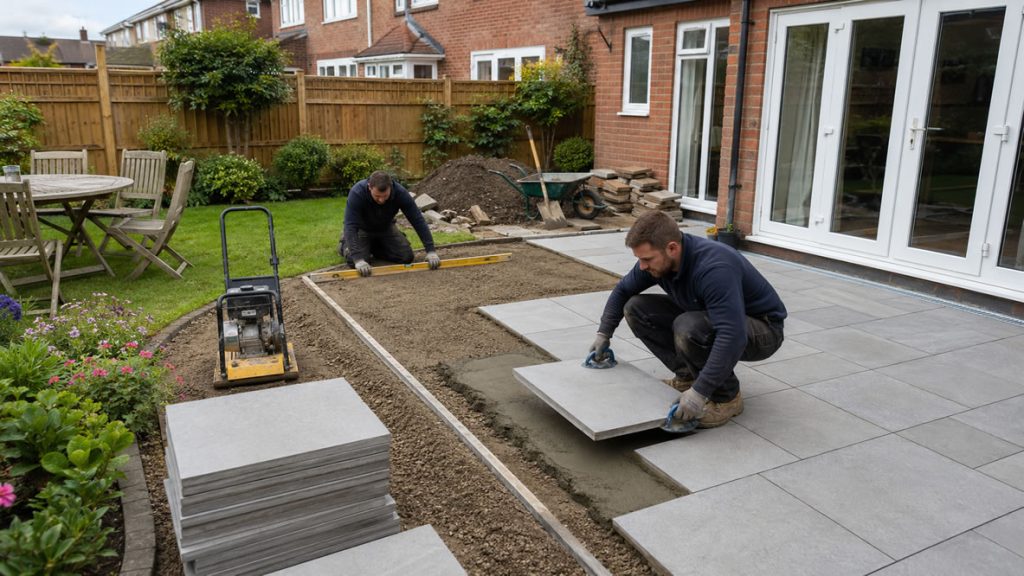
A properly installed patio normally requires much more than simply laying slabs on the ground.
Typical work includes:
- marking out the patio
- removing turf or an existing surface
- excavating the ground
- removing soil and waste
- compacting the subgrade
- laying a suitable sub-base
- installing drainage where needed
- preparing a mortar bed
- laying the paving
- cutting edge slabs
- forming falls for drainage
- jointing or pointing
- cleaning the finished patio
The quality of the preparation underneath the paving is extremely important.
Poor groundwork can lead to:
- sinking slabs
- rocking slabs
- cracked joints
- puddles
- uneven surfaces
- weeds
- loose paving
For that reason, the cheapest quote is not always the best value.
Concrete paving slab quotes
Concrete paving remains one of the most affordable patio options.
Installed prices may start at around £50 to £90 per m².
Concrete slabs are available in:
- smooth finishes
- riven stone-effect finishes
- textured surfaces
- contemporary large-format slabs
- traditional square paving
Advantages of concrete paving
Concrete offers:
- relatively low cost
- wide availability
- plenty of colours
- many sizes and patterns
- straightforward replacement
Disadvantages
Possible drawbacks include:
- colour fading
- surface weathering
- staining
- moss and algae growth
- less premium appearance
Good-quality concrete can still provide an attractive and practical patio for many years.
Indian sandstone patio quotes
Indian sandstone remains very popular in British gardens.
It has a natural, slightly varied appearance and works especially well with:
- traditional homes
- cottages
- brick houses
- informal gardens
Typical installed prices may sit around £70 to £130 per m².
Sandstone often comes in mixed-size patio packs containing several slab dimensions.
This creates a traditional random laying pattern.
Advantages of sandstone
Sandstone offers:
- natural appearance
- attractive colour variation
- good availability
- traditional character
- generally lower cost than premium stone
Popular colour groups include:
- buff
- grey
- brown
- warm mixed tones
Does sandstone need sealing?
It does not always need sealing, but homeowners sometimes choose to seal it.
A suitable sealer may help:
- reduce staining
- make cleaning easier
- limit water absorption
- enhance colour
However, the patio should be correctly prepared before sealing.
Poorly applied sealer can create:
- patchy colour
- trapped moisture
- uneven sheen
- visible marks
Ask the installer whether the stone needs sealing and which product suits it.
Porcelain patio quotes
Porcelain has become one of the most popular premium patio materials.
Installed costs commonly sit around £90 to £180 per m².
Porcelain is manufactured rather than quarried, which means it can replicate:
- natural stone
- concrete
- timber
- slate
while maintaining a very consistent finish.
Advantages of porcelain patios
Porcelain provides:
- very low water absorption
- good stain resistance
- colour stability
- low maintenance
- modern appearance
- large slab sizes
- consistent thickness
It works especially well for contemporary garden designs.
Why does porcelain cost more to install?
Porcelain paving is harder and more difficult to cut than many traditional slabs.
Installers often need:
- specialist diamond blades
- suitable wet cutting equipment
- slurry primer
- experienced labour
- careful handling
The paving normally needs a full mortar bed rather than being spot-bedded.
Therefore, labour costs can be higher than for simple concrete paving.
What thickness should outdoor porcelain be?
Outdoor porcelain paving is commonly around 20mm thick.
Thinner indoor porcelain tiles should not simply be substituted for purpose-made outdoor paving.
The paving needs to suit:
- external use
- frost exposure
- foot traffic
- the intended installation method
Always check the product specification.
Limestone patio quotes
Limestone creates a smoother natural-stone appearance.
Typical installed costs may sit around £90 to £150 or more per m².
Colours can include:
- black
- blue-grey
- beige
- cream
Limestone can look particularly good around:
- modern extensions
- contemporary planting
- older stone properties
However, some limestone changes colour as it weathers.
Granite patio quotes
Granite sits toward the premium end.
Installed prices may reach around £120 to £220 per m² or more.
Granite is:
- hard
- durable
- frost resistant
- visually distinctive
It works well for homeowners looking for a premium, long-lasting patio.
The material is heavy and difficult to cut, which increases labour costs.
Natural stone or porcelain?
This is one of the most common decisions.
Choose natural stone if you prefer:
- individual colour variation
- traditional character
- a more organic appearance
- naturally aged surfaces
Choose porcelain if you prefer:
- consistent colour
- low maintenance
- crisp edges
- modern styling
- strong stain resistance
Both can produce an excellent patio.
The better choice depends largely on the property and garden design.
Porcelain vs sandstone comparison
| Feature | Porcelain | Sandstone |
| Typical installed cost | £90–£180/m² | £70–£130/m² |
| Maintenance | Low | Moderate |
| Colour consistency | Excellent | Naturally varied |
| Stain resistance | Excellent | Moderate |
| Traditional appearance | Good | Excellent |
| Modern appearance | Excellent | Good |
| Cutting difficulty | High | Moderate |
| Sealing | Usually not required | Optional |
| Natural variation | Low | High |
For modern patios, porcelain often wins.
For traditional gardens, sandstone remains extremely popular.
Patio groundwork costs
Preparation is one of the biggest parts of the installation.
A contractor may need to excavate around 150mm or more, depending on ground conditions and paving specification.
The groundwork may include:
- soil removal
- Type 1 sub-base
- compaction
- mortar
- drainage
A typical sub-base supply and installation cost may add around £30 to £50 per m².
Excavating and disposing of an old patio can add around £20 to £50 per m².
Why does the sub-base matter?
A patio needs a firm foundation.
Without a properly compacted sub-base, paving may:
- sink
- move
- crack
- become uneven
The installer usually builds the sub-base in layers and compacts it using a vibrating plate.
Ground conditions determine the exact depth required.
Soft or wet ground may need more preparation.
Patio drainage
A patio should not trap water against the house.
The finished paving normally needs a slight fall so rainwater runs towards:
- a garden area
- suitable drainage
- a channel drain
- a soakaway
The installer should plan drainage before laying the first slab.
How much fall should a patio have?
The patio normally needs a subtle slope away from buildings.
It should be enough to move rainwater without making the surface feel obviously sloped.
The exact fall depends on:
- paving type
- patio length
- surrounding levels
- drainage arrangement
An experienced patio installer should set this out during construction.
Patio levels near the house
The new paving should not simply be raised against the house wall without consideration of the damp-proof course.
Incorrect patio levels can contribute to damp problems.
The installer should check:
- existing damp-proof course level
- air bricks
- door thresholds
- drainage
- external wall finishes
This is especially important when laying over an old patio.
Can you lay a new patio over an old one?
Sometimes, but it is often better to remove the existing paving.
Laying directly over an old patio can cause problems if the old base:
- has moved
- drains badly
- contains loose slabs
- already sits too high
- has cracks
A structurally sound concrete base may occasionally be suitable for some new paving systems.
However, the installer should inspect it first.
Should old paving be removed?
Removal usually makes sense when:
- slabs rock
- paving has sunk
- water pools
- the existing patio sits too high
- the layout is changing
- the base condition is unknown
Removing it gives the installer the chance to rebuild the patio properly.
Patio edging
Patio edges can be finished in several ways.
Options include:
- matching slabs
- contrasting blocks
- stone setts
- brick edging
- metal edging
- raised kerbs
Borders can add definition between the patio and:
- lawn
- gravel
- flower beds
- paths
Decorative edging usually adds to labour and material costs.
Patio steps
Steps can significantly increase a patio quote.
They may be required where:
- garden levels change
- the patio sits below a raised house
- doors open onto a higher threshold
- the garden slopes
Steps need careful construction so they are:
- stable
- evenly sized
- comfortable to use
- properly drained
Complex stone or porcelain steps can add several hundred pounds or more.
Retaining walls
Sloping gardens may need retaining walls.
These can be constructed from:
- brick
- concrete blocks
- sleepers
- stone
- rendered blockwork
Retaining walls can quickly increase the total project price because they involve additional:
- excavation
- foundations
- drainage
- masonry
- materials
Therefore, a £3,000 paving job can become a £6,000 landscaping project when major level changes are involved.
Patio jointing
The gaps between paving need an appropriate jointing system.
Common options include:
- traditional mortar pointing
- resin jointing compound
- brush-in compound
The correct choice depends on:
- slab type
- joint width
- installation method
- appearance
Porcelain often uses specialist jointing products.
Natural stone can use mortar or suitable compounds.
Patio pointing repair
Over time, old patio joints can crack or wash out.
Repointing can sometimes restore an otherwise sound patio without complete replacement.
Typical patio repointing might cost around £20 to £40 per m², depending on:
- joint condition
- existing mortar
- cleaning required
- new jointing material
However, repointing will not fix slabs that are moving because the base underneath has failed.
Patio cleaning and maintenance
All patios need some maintenance.
Typical tasks include:
- sweeping
- removing leaves
- washing surfaces
- treating algae
- cleaning joints
- removing weeds
Porcelain generally needs the least maintenance.
Natural stone may need more care because its surface absorbs more moisture.
Pressure washing patios
Pressure washing can be effective, but it should be done carefully.
Excessive pressure can:
- remove jointing material
- damage softer stone
- mark concrete
- disturb unstable slabs
For routine cleaning, a lower-pressure method may be enough.
Patio lifespan
A well-installed patio can last for decades.
| Patio Material | Broad Expected Lifespan |
| Concrete slabs | 15–25+ years |
| Sandstone | 20–30+ years |
| Limestone | 20–30+ years |
| Porcelain | 25–30+ years |
| Granite | 30–50+ years |
| Block paving | 20–30+ years |
The base often fails before good-quality paving does.
That is another reason proper installation matters.
How long does patio installation take?
Typical timescales include:
| Patio Size | Typical Installation Time |
| 10m² | 2–3 days |
| 20m² | 3–5 days |
| 30m² | 5–7 days |
| 40m² | 7–10 days |
| Large or complex project | 1–3 weeks |
Bad weather can extend the schedule.
Difficult garden access
Rear garden access can make a surprisingly large difference to the price.
Easy access allows contractors to use:
- mini diggers
- dumpers
- mechanical compactors
- bulk deliveries
Terraced properties can be more difficult.
If everything has to pass through the house or a narrow side passage, labour costs increase.
The installer may need to move:
- excavated soil
- hardcore
- sand
- cement
- paving
by wheelbarrow.
How much does waste removal cost?
Old paving and excavated soil need removing from the property.
Waste disposal may involve:
- skips
- grab lorries
- tipper vehicles
- licensed waste facilities
A quote should clearly state whether removal is included.
Do not assume that a cheap installation price includes disposal.
Patio or decking?
Patios and decking can both create useful seating areas.
Patio advantages
- durable
- low maintenance
- good for furniture
- large material choice
- no timber treatment required
Decking advantages
- useful over uneven ground
- can create raised areas
- timber has a warmer appearance
- quicker installation in some situations
A patio generally provides a more solid, permanent surface.
Patio or gravel seating area?
Gravel can be much cheaper.
It also drains naturally.
However, gravel can:
- move under furniture
- spread onto lawns
- feel less stable
- become difficult for wheelchairs or pushchairs
A paved patio generally provides the most practical surface for outdoor dining.
How big should a patio be?
Think about how you plan to use it.
Small bistro patio
Around 6–10m² can suit:
- two chairs
- small table
- coffee area
Family dining patio
Around 15–25m² provides room for:
- dining table
- chairs
- barbecue
Large entertaining area
Around 30–40m² or more can accommodate:
- dining furniture
- outdoor sofa
- barbecue
- planters
- circulation space
Marking the proposed area with string before installation can help you judge the size.
Where should the patio go?
Many patios sit directly outside the rear doors.
This creates a convenient connection between:
- kitchen
- dining room
- garden
However, the sunniest part of the garden may sit somewhere else.
Some homeowners create:
- a main patio beside the house
- a smaller seating area at the end of the garden
Think about sun, shade and privacy before choosing the location.
Does patio installation need planning permission?
Most ordinary domestic patios do not need planning permission.
However, unusual circumstances may require further checks.
These can include:
- listed buildings
- substantial raised platforms
- major retaining structures
- drainage changes
- conservation restrictions
If the project significantly alters ground levels or creates raised structures, check before work begins.
What affects patio installation quotes?
Patio size
Larger areas need more materials and labour.
Paving material
Basic concrete costs far less than premium granite.
Ground condition
Soft or unstable soil increases preparation costs.
Existing paving
Removing old concrete or slabs costs extra.
Access
Poor access increases labour.
Drainage
Channels and soakaways add cost.
Steps
Changes in garden level require more construction.
Retaining walls
These can add thousands to a larger project.
Cutting
Detailed patterns and awkward boundaries create more labour.
Paving size
Very large slabs can be harder to handle.
Location
Labour costs tend to be higher in London and the South East.
What should a patio installation quote include?
Look for:
| Quote Item | What to Check |
| Excavation | Depth and area included |
| Waste removal | Included? |
| Sub-base | Material and depth |
| Compaction | Included? |
| Paving | Exact product |
| Bedding | Full mortar bed? |
| Primer | Included where required? |
| Drainage | How will water be managed? |
| Edging | Included? |
| Steps | Included? |
| Cutting | Included? |
| Jointing | Exact system |
| Cleaning | Final clean included? |
| Labour | Included? |
| VAT | Included or additional? |
The most useful quotes explain how the patio will actually be built.
Common patio installation mistakes
Laying slabs on soil
Paving needs a stable base.
Spot bedding slabs
Using small blobs of mortar rather than proper support can create weak spots.
Poor drainage
Water can pool or run towards the house.
Raising paving too high
This can cause problems around the damp-proof course.
Choosing indoor tiles
Indoor porcelain is not automatically suitable for exterior use.
Ignoring access
A cheap material price means little if labour costs are high because access is difficult.
Choosing slabs before seeing samples
Colours online can look very different outdoors.
Should you choose the cheapest patio quote?
Not automatically.
Compare:
- excavation depth
- sub-base thickness
- paving product
- drainage
- bedding method
- jointing
- waste removal
A contractor who skips groundwork can often quote substantially less.
However, repairing a sinking patio later can cost far more.
Questions to ask a patio installer
Before accepting a quotation, ask:
- How deep will you excavate?
- What sub-base will you use?
- How will you compact it?
- Will the slabs sit on a full mortar bed?
- Does porcelain need a primer?
- How will the patio drain?
- Where will rainwater go?
- How will you deal with the damp-proof course?
- Is waste removal included?
- Which paving product is included?
- Are steps and edging included?
- What jointing system will you use?
- How long will installation take?
- What guarantee do you provide?
Clear answers make comparing contractors much easier.
Get patio installation quotes
Patio installation prices depend on the paving material, size, access and amount of groundwork required.
Concrete provides one of the cheapest options, while sandstone offers natural character at a reasonable price. Porcelain has become particularly popular for modern gardens because it provides a clean appearance and needs relatively little maintenance.
However, the paving itself is only part of a good patio.
Correct excavation, sub-base preparation, drainage and laying methods play an equally important role in how long the finished patio lasts.
Use the quotation form on this page to compare patio installation quotes from local paving and landscaping specialists.
Frequently Asked Questions
How much does patio installation cost in the UK?
A professionally installed patio commonly costs around £50 to £180 per m², depending on paving type and groundwork. Premium natural stone can cost more than £200 per m².
How much does a 20m² patio cost?
A typical 20m² patio may cost around £1,200 to £3,600 or more, depending on whether you choose concrete, sandstone, porcelain or premium natural stone.
How much does porcelain patio installation cost?
Porcelain paving commonly costs around £90 to £180 per m² supplied and installed.
How much does Indian sandstone paving cost?
Indian sandstone typically costs around £70 to £130 per m² installed.
What is the cheapest patio material?
Basic concrete paving slabs are normally one of the cheapest options, with installed costs starting around £50 per m².
Is porcelain better than sandstone?
Porcelain generally needs less maintenance and provides a more consistent finish. Sandstone offers more natural variation and often costs less.
Does a new patio need a sub-base?
Yes. A properly compacted sub-base helps prevent movement, sinking and cracked joints.
Can a patio be laid over old slabs?
Sometimes, but only where the existing base is stable and levels remain suitable. In many cases, removing the old patio and rebuilding the base provides a better result.
How long does patio installation take?
A typical 20m² patio may take around three to five working days. Larger or more complicated projects can take one to two weeks or longer.
Do patios need drainage?
Yes. The patio should be designed so rainwater runs away from the house and towards a suitable drainage or permeable area.
How long does a patio last?
A properly installed patio can last 20 to 30 years or longer. Premium stone may last considerably longer.
Should I compare several patio quotes?
Yes. Compare groundwork, sub-base specification, paving materials, drainage, jointing and waste removal rather than considering only the final price.