
Need driveway paving?
We can arrange for up to 4 local tradesmen to contact you with free, no-obligation quotes
* Required fields.
A new driveway can completely change the front of a property. It can provide more practical parking, improve kerb appeal and make an old or untidy frontage much easier to maintain.
However, driveway paving prices vary considerably. A simple gravel driveway over a sound base may cost relatively little. In contrast, a large block-paved driveway that needs excavation, drainage, new edging and extensive preparation can cost several thousand pounds.
The surface itself is only one part of the quote. Ground preparation, drainage and the sub-base often make just as much difference to the final price.
As a broad UK guide, a professionally installed driveway can cost around £60 to £120 per m². Gravel normally sits at the cheaper end, while block paving and resin-bound surfaces tend to cost more. A typical two-car driveway of around 50m² may therefore cost anywhere from approximately £3,000 to £6,500 or more, depending on the material and amount of groundwork required.
This guide explains typical driveway paving costs, the most popular materials, what affects the quote and what homeowners should compare before choosing a driveway contractor.
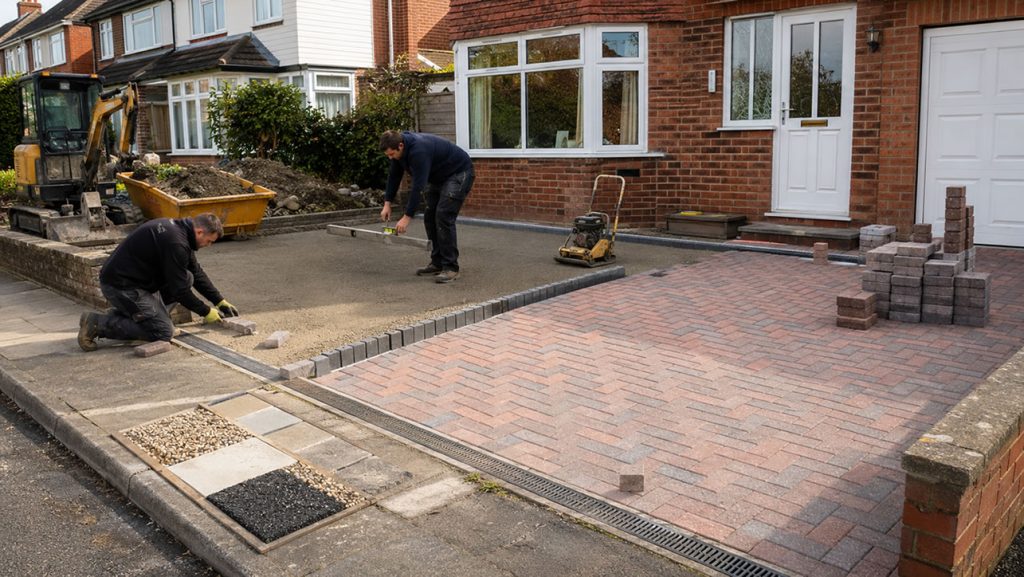
What does driveway paving involve?
Driveway paving means creating a hard-wearing surface suitable for regular vehicle use.
Depending on the property and material, the work may involve:
- removing an existing driveway
- excavating soil
- disposing of waste
- installing a sub-base
- compacting the ground
- adding drainage
- installing kerbs or edging
- laying block paving, slabs or another surface
- cutting around drains and inspection covers
- compacting or finishing the surface
- cleaning the site afterwards
Good driveway installation starts below the surface. Attractive paving laid over a poor base can move, sink or develop drainage problems surprisingly quickly.
How much does a new driveway cost?
The material makes a significant difference.
| Driveway Material | Typical Installed Cost |
|---|---|
| Gravel | Around £60 per m² |
| Tarmac driveway | Around £90 per m² |
| Concrete | Around £90–£100 per m² |
| Brick paving | Around £95–£110 per m² |
| Block paving | Around £90–£120 per m² |
| Resin bound | Around £100–£130+ per m² |
| Natural stone paving | Around £100–£150+ per m² |
These figures should only be used as a starting point.
A driveway with minimal preparation may cost less. However, excavation, difficult drainage, retaining walls or premium paving can push the cost considerably higher.
Typical driveway costs by size
Driveway size matters because larger projects need more materials and labour.
| Driveway Size | Typical Use | Approximate Project Cost |
| 15–20m² | Small single-car driveway | £1,500–£3,000+ |
| 25–35m² | Large single-car driveway | £2,000–£4,500+ |
| 40–50m² | Typical two-car driveway | £3,000–£6,500+ |
| 60–80m² | Large two or three-car drive | £4,500–£9,000+ |
| 100m² | Large frontage | £6,000–£12,000+ |
Premium natural stone and detailed block paving can exceed these ranges.
Block paving driveway quotes
Block paving remains one of the most popular driveway choices in the UK.
Concrete blocks come in a wide range of:
- colours
- sizes
- textures
- shapes
- laying patterns
Homeowners can also combine different colours to create borders, parking bays and decorative features.
A typical block-paved driveway may cost around £90 to £120 per m² once materials and installation are included.
A standard 50m² driveway could therefore cost around £4,500 to £6,500.
Advantages of block paving
Block paving offers:
- attractive appearance
- a large choice of colours
- good durability
- individual blocks that can be replaced
- easy access to underground services
- plenty of design flexibility
Disadvantages of block paving
Possible drawbacks include:
- weeds appearing in joints
- settlement if the base is poor
- occasional re-sanding
- more installation labour
- higher price than gravel or basic tarmac
Correct groundwork matters enormously.
Concrete block or clay block paving?
Most residential block paving uses concrete.
Concrete blocks generally cost less and provide a wider choice of colours and finishes.
Clay pavers usually cost more, but many homeowners like their more traditional appearance.
Clay also tends to retain its colour well because the colour runs through the material rather than sitting mainly at the surface.
| Feature | Concrete Blocks | Clay Pavers |
| Initial cost | Lower | Higher |
| Colour range | Excellent | Good |
| Traditional appearance | Good | Excellent |
| Colour retention | Good | Excellent |
| Availability | Excellent | More limited |
| Installation | Straightforward | Similar |
For most driveways, concrete block paving gives the best balance between cost and appearance.
Natural stone driveway paving
Natural stone can produce a premium driveway.
Common materials include:
- granite
- sandstone
- limestone
- setts
- cobbles
Stone varies naturally in colour and texture, so the driveway can look less uniform than manufactured paving.
However, the cost tends to be higher.
Good natural stone driveway paving may cost around £100 to £150 per m² or more depending on the stone.
The installer must also choose paving that is genuinely suitable for vehicle loading. Not every patio slab makes a suitable driveway surface.
Can patio slabs be used on a driveway?
Sometimes, but only if the slabs are designed for vehicle use.
Standard patio slabs may crack under:
- vehicle weight
- turning forces
- repeated wheel loads
- poor support
Driveway paving needs enough thickness and strength for cars.
Therefore, if you prefer the appearance of slabs, ask the supplier or installer to confirm that the product is rated for driveway use.
Porcelain driveway products, concrete driveway slabs and suitable natural stone can all work when installed to the correct specification.
Tarmac driveway quotes
Tarmac remains a practical choice for many UK homes.
A typical professionally installed tarmac driveway costs around £90 per m², although prices vary according to size and groundwork.
For example:
| Driveway Size | Typical Tarmac Price |
| 20m² | Around £2,000–£2,500 |
| 50m² | Around £4,000–£4,500 |
| 100m² | Around £7,000+ |
Tarmac often becomes more cost-effective on larger areas because installation is relatively quick.
Advantages of tarmac
- strong and durable
- relatively quick installation
- works well on larger driveways
- relatively low maintenance
- usually cheaper than decorative paving
Disadvantages of tarmac
- fewer design choices
- patches can remain visible
- oil spills can mark the surface
- edging needs careful installation
Block edging is often used around tarmac to create a more decorative finish.
Resin-bound driveway quotes
Resin-bound driveways have become increasingly popular because they provide a smooth, decorative finish.
The installer mixes aggregate with resin and lays it over a suitable prepared base.
Typical installed prices currently sit around £100 to £130 per m².
A medium 50m² driveway may therefore cost around £5,000 to £6,500 or more.
Advantages of resin bound
- modern appearance
- large colour choice
- smooth surface
- relatively low maintenance
- permeable when installed as part of the correct system
- good for contemporary properties
Disadvantages
- higher cost
- installation depends heavily on weather
- poor-quality resin can discolour
- base preparation is critical
- repairs can be visible
Resin should not simply be laid over a failing base.
Gravel driveway quotes
Gravel remains one of the cheapest driveway surfaces.
Typical installed costs sit around £50 to £70 per m².
A 50m² gravel driveway may therefore cost roughly £2,500 to £3,500, depending on groundwork.
Advantages
- low initial cost
- quick installation
- good natural drainage
- wide choice of aggregate
- easy to top up
Disadvantages
- stones can migrate
- weeds may appear
- wheel tracks can develop
- difficult for pushchairs or wheelchairs
- gravel can move onto pavements
Using proper edging and a gravel stabilisation grid can improve performance.
Concrete driveway quotes
Concrete is strong and durable.
A straightforward concrete driveway may cost around £80 to £110 per m².
Decorative finishes can cost considerably more.
Options include:
- brushed concrete
- coloured concrete
- patterned concrete
- imprinted concrete
Concrete needs proper joints and drainage because cracking can occur if the base or slab design is poor.
Which driveway surface is cheapest?
For most homes, gravel provides the cheapest professionally installed option.
A simple ranking looks like this:
- Gravel
- Tarmac
- Concrete
- Block paving
- Resin bound
- Premium natural stone
However, price should not be the only consideration.
Maintenance, appearance and lifespan also matter.
A cheaper surface that needs frequent repair can eventually cost more than a properly installed higher-priced alternative.
How important is driveway groundwork?
Extremely important.
Most driveway failures begin underneath the finished surface.
A proper installation may involve excavating to a suitable depth and constructing layers such as:
- compacted subgrade
- geotextile membrane where appropriate
- Type 1 sub-base
- laying course
- final surface
The exact construction depends on the driveway material and ground conditions.
Skipping sub-base preparation is one of the easiest ways to create future problems.
How much does excavation cost?
Excavation may cost around £30 to £50 per m² depending on depth, access and waste.
The contractor may need:
- mini digger
- skips
- grab lorry
- labour
- disposal fees
Removing old reinforced concrete can cost more than excavating soft ground.
Therefore, ask whether excavation and waste disposal are included in your quote.
Drainage for new driveways
Drainage is an important part of driveway design.
Large impermeable areas can create a significant amount of surface water during heavy rain.
Possible drainage solutions include:
- permeable block paving
- resin-bound permeable systems
- gravel
- soakaways
- drainage channels
- directing water towards garden areas
The correct solution depends on the property.
Do I need planning permission for a driveway?
In many circumstances, householders can pave over a front garden without planning permission if the new surface is permeable or drains water to a permeable area within the property.
However, planning rules can apply where a large impermeable surface sends water directly towards the highway or public drainage system.
Therefore, the drainage design should form part of the driveway quotation.
Listed properties, conservation areas and unusual sites may also need additional checks.
What is a dropped kerb?
If vehicles need to cross a pavement to reach the driveway, you normally need an approved dropped kerb or vehicle crossover.
This usually involves lowering the pavement kerbs and strengthening the pavement crossing.
The local highway authority controls the approval process.
Do not assume that creating a driveway automatically gives permission to drive across the pavement.
A driveway contractor may be able to advise on the process, but approval usually sits with the relevant council.
Can you turn a front garden into a driveway?
Often, yes.
This is increasingly popular where homeowners want extra parking.
The work may involve:
- removing lawn
- removing planting
- reducing soil levels
- installing a sub-base
- adding drainage
- creating paving
- widening an existing driveway
- applying for a dropped kerb
However, check whether boundary walls, trees, planning restrictions or highway rules affect the project.
What affects driveway paving quotes?
Driveway size
Larger driveways need more material and labour.
However, the cost per square metre can sometimes fall slightly on larger straightforward projects.
Surface material
Gravel costs much less than premium stone.
Excavation
Removing existing concrete or deep foundations adds labour and disposal cost.
Ground conditions
Soft or unstable ground may need additional excavation and sub-base.
Drainage
Channels, soakaways and permeable systems increase the initial cost.
Edging
Decorative borders and kerbs add both materials and labour.
Manholes
Inspection covers may need raising, replacing or installing with recessed paving trays.
Access
Narrow driveways can make using excavators and delivery vehicles more difficult.
Site levels
Sloping driveways may need retaining walls, steps or additional drainage.
Waste disposal
Excavated soil, old paving and concrete need appropriate disposal.
Decorative driveway features
Homeowners can personalise block-paved and slabbed driveways with:
- contrasting borders
- circular patterns
- parking bay outlines
- paths
- entrance aprons
- drainage channels
- stone edging
- feature bands
These details can make the driveway look more distinctive.
However, they also involve additional cutting and labour.
How long does driveway installation take?
A small straightforward driveway may take less than a week.
A larger installation can take one to two weeks or longer.
| Project | Typical Timescale |
| Small gravel driveway | 2–4 days |
| Small tarmac driveway | 3–5 days |
| Block paving driveway | 5–10 days |
| Resin-bound driveway | 4–8 days |
| Large complex driveway | 1–3 weeks |
Weather can affect the schedule, particularly with resin and tarmac work.
How long does driveway paving last?
Lifespan depends on material and installation quality.
| Surface | Broad Expected Lifespan |
| Gravel | Indefinite with topping up |
| Tarmac | 15–25+ years |
| Concrete | 20–30+ years |
| Block paving | 20–30+ years |
| Resin bound | 15–25+ years |
| Natural stone | 30–50+ years |
A strong sub-base can make more difference than choosing the most expensive surface.
Does block paving need maintenance?
Yes, although the work is fairly straightforward.
Maintenance may include:
- sweeping
- occasional pressure cleaning
- weed removal
- re-sanding joints
- replacing damaged blocks
- removing oil stains
Over time, kiln-dried sand may wash out of the joints.
Replacing it helps keep the blocks stable.
Does a driveway add value to a house?
A useful driveway can improve a property’s appeal, especially in areas where on-street parking is limited.
However, value depends on:
- location
- parking demand
- quality of installation
- driveway size
- appearance
- loss of garden space
A badly designed driveway that removes all planting and causes drainage problems may not create the same benefit.
Combining parking with planting and good landscaping often provides a more attractive result.
Should you resurface or replace an existing driveway?
Resurfacing may work when:
- the base remains solid
- cracks are limited
- drainage works correctly
- there is no widespread settlement
Replacement usually makes more sense when:
- large areas have sunk
- the base has failed
- drainage is poor
- paving continually moves
- tree roots have caused damage
- the existing surface is heavily cracked
Installing an attractive new surface over a failing base rarely solves the underlying problem.
Should you seal block paving?
Sealing is optional.
A suitable block paving sealer may:
- reduce staining
- help stabilise jointing sand
- enhance colour
- make cleaning easier
However, the paving must be clean and dry before application.
Poor sealing can trap dirt, create a patchy finish or become slippery.
How to compare driveway paving quotes
Get several detailed quotations rather than comparing a single headline price.
Ask each contractor to show:
| Quote Item | What to Check |
| Excavation | What depth will be removed? |
| Waste | Is removal included? |
| Sub-base | What material and depth will be installed? |
| Paving | Exact manufacturer and product |
| Laying course | What specification will be used? |
| Drainage | Are channels or soakaways included? |
| Edging | What kerbs or borders are included? |
| Manholes | Are adjustments included? |
| Labour | Fully included? |
| Machinery | Included in total? |
| VAT | Included or additional? |
| Guarantee | What work is covered? |
If one quote is dramatically cheaper, compare the groundwork specification carefully.
Common driveway paving mistakes
Choosing only by price
The cheapest paving quote may include less excavation or a thinner sub-base.
Poor drainage
Water should not collect against the house or run directly onto the pavement.
Weak edging
Driveway edges need proper restraint to stop paving spreading.
Inadequate sub-base
This can cause sinking and rutting.
Using patio slabs on a driveway
Unless the product is rated for vehicles, slabs may crack.
Ignoring inspection chambers
Manhole covers need to remain accessible.
Forgetting the dropped kerb
You may need highway approval before vehicles legally cross the pavement.
Should you choose paving or tarmac?
Block paving generally provides more design choice and easier individual repairs.
Tarmac generally costs slightly less and works particularly well on larger areas.
Choose paving when:
- appearance matters
- you want borders or patterns
- future access to services matters
- the property suits a decorative finish
Choose tarmac when:
- budget matters
- you have a larger driveway
- you want quick installation
- a simple dark surface suits the property
Paving or resin?
Resin produces a smooth and contemporary finish.
Block paving provides more traditional detailing and allows individual sections to be lifted.
Resin may work better when:
- a seamless appearance matters
- accessibility matters
- you want small decorative aggregate
Block paving may work better when:
- you prefer clearly defined patterns
- you may need access beneath the driveway
- individual repairability matters
Both can provide excellent results when the groundwork is correct.
Questions to ask a driveway contractor
Before accepting a quotation, ask:
- How deep will you excavate?
- What sub-base will you use?
- How thick will the sub-base be?
- How will you compact it?
- How will the driveway drain?
- Is the paving suitable for vehicle traffic?
- Are borders included?
- What happens around inspection covers?
- Who removes waste?
- Do I need a dropped kerb?
- How long will installation take?
- When can vehicles use the finished driveway?
- What guarantee do you provide?
Good contractors should be able to explain the construction rather than discussing only the visible paving.
Get driveway paving quotes
Driveway paving prices vary depending on the size of the area, surface material, groundwork and drainage.
For many homeowners, block paving offers an attractive balance between appearance, durability and repairability. Gravel and tarmac can reduce the initial cost, while resin and natural stone provide more premium finishes.
The most important part of any driveway is the preparation underneath. Therefore, compare the complete installation specification rather than choosing the cheapest price per square metre.
Use the quotation form on this page to compare driveway paving quotes from local driveway and paving specialists.
Frequently Asked Questions
How much does driveway paving cost in the UK?
A professionally installed driveway commonly costs around £60 to £120 per m². Gravel sits toward the lower end, while block paving and resin normally cost more.
How much does a block-paved driveway cost?
Block paving commonly costs around £90 to £120 per m². A typical 50m² two-car driveway may cost approximately £4,500 to £6,500.
What is the cheapest driveway surface?
Gravel is usually the cheapest mainstream option, often costing around £50 to £70 per m² when professionally installed.
Is tarmac cheaper than block paving?
Usually, yes. Tarmac typically costs around £90 per m², while block paving often costs around £100 per m² or more.
How much does a resin driveway cost?
A resin-bound driveway often costs around £100 to £130 per m². A 50m² driveway may therefore cost approximately £5,000 to £6,500 or more.
How much does driveway excavation cost?
Excavation and waste removal can add around £30 to £50 per m², depending on the existing surface, depth and access.
Do I need drainage for a new driveway?
Yes, the driveway needs a suitable way to deal with surface water. This may involve permeable paving, drainage channels, soakaways or directing water towards a permeable area.
Do I need planning permission for a driveway?
Many domestic driveways can be installed without planning permission where surface water drains through a permeable surface or to a suitable permeable area. Different rules may apply to impermeable front-garden paving, listed buildings and restricted properties.
Do I need a dropped kerb?
If you need to drive across a public pavement to access the driveway, you will normally need an approved dropped kerb or vehicle crossover.
How long does block paving last?
A correctly installed block-paved driveway can often last 20 to 30 years or longer, particularly when the sub-base is sound and routine maintenance is carried out.
Can I use patio slabs for a driveway?
Only if the paving product is designed to cope with vehicle loads. Standard patio slabs may crack when cars drive over them.
Should I get more than one driveway quote?
Yes. Compare several detailed quotations and pay particular attention to excavation depth, sub-base specification, drainage, edging and waste removal.