
Getting Asbestos Survey and Testing Quotes
We can arrange for up to 4 local tradesmen to contact you with free, no-obligation quotes
* Required fields.
If your home was built or refurbished before 2000, there is a chance that some materials could contain asbestos. That does not automatically mean there is a problem. In many cases, asbestos-containing materials can remain safely in place when they are in good condition and unlikely to be disturbed.
However, the situation changes if you are planning building work, removing an old garage roof, knocking through walls, replacing ceilings or carrying out a major renovation. Before contractors start disturbing materials, it makes sense to establish whether asbestos is present.
That is where an asbestos survey or asbestos test comes in.
For homeowners, the terminology can be confusing. You may be offered a simple asbestos sample test, a management survey or a refurbishment and demolition survey. These services do different jobs and can vary considerably in price.
As a broad UK guide, a simple asbestos sample and laboratory test may cost around £50 to £150, while a domestic management survey often costs around £150 to £350. A more intrusive refurbishment or demolition survey may start at approximately £300 to £400, although larger homes and complex renovation projects can cost considerably more.
This guide explains the different types of asbestos surveys and testing, what they cost, when each option is suitable and what homeowners should check when comparing asbestos quotes.
What is an asbestos survey?
An asbestos survey is an inspection designed to identify materials that contain, or could contain, asbestos.
A competent asbestos surveyor may inspect materials such as:
- textured coatings
- ceiling tiles
- insulation boards
- soffits
- fascia boards
- garage roof sheets
- cement panels
- boiler cupboards
- pipe insulation
- vinyl floor tiles
- old adhesives
- flue pipes
- partition walls
- roofing products
Depending on the type of survey, the surveyor may also take samples and send them to a laboratory for analysis.
The finished report should identify the materials inspected, their location and condition, and whether asbestos was confirmed or presumed.
Asbestos survey or asbestos test: what is the difference?
These terms are often used interchangeably, but they are not quite the same thing.
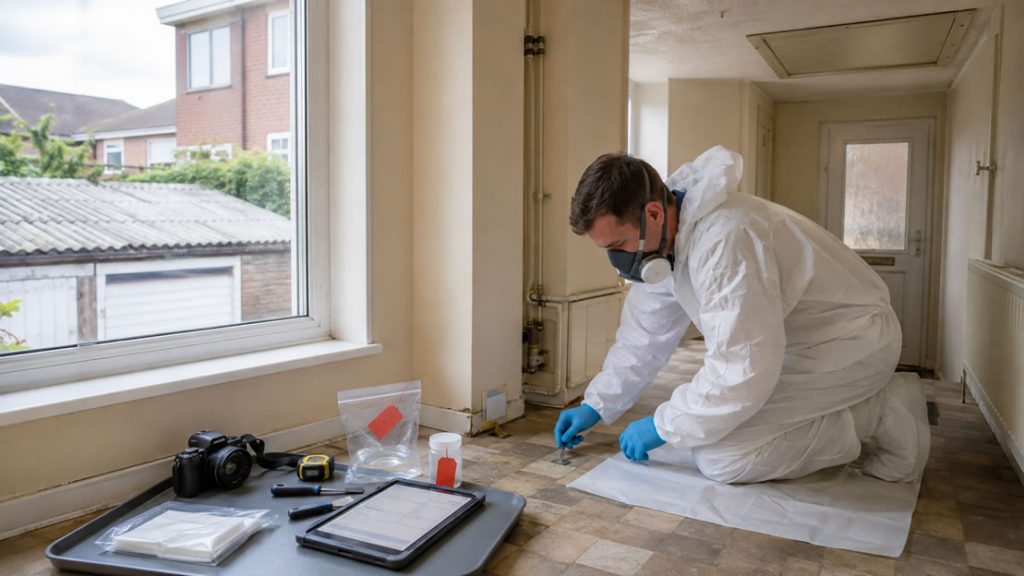
Asbestos testing
Testing normally means taking a sample from one or more suspect materials and sending it to a laboratory.
For example, you might want to know whether:
- a garage roof contains asbestos
- an Artex-style ceiling contains asbestos
- old floor tiles contain asbestos
- soffit boards contain asbestos
- a cement water tank contains asbestos
Testing answers a fairly specific question.
Asbestos survey
A survey looks at a wider area or whole property.
The surveyor searches for potential asbestos-containing materials, records their locations and may take several samples.
Therefore, a survey is usually more appropriate where you do not already know which materials may contain asbestos.
When is asbestos testing enough?
A simple test may be enough if you have identified one specific material and only need to know whether it contains asbestos.
Typical examples include:
- an old garage roof
- one textured ceiling
- a section of floor tiles
- a single cement panel
- one soffit board
- an old flue pipe
If a contractor only needs confirmation about one known material before removing it, sampling may provide the information required.
However, testing one item does not prove that the rest of the property is asbestos-free.
When is a full survey better?
A survey makes more sense when:
- you are buying an older property
- you are planning extensive renovation
- several suspect materials are present
- you do not know where asbestos may be located
- walls or ceilings will be opened
- the property will be demolished
- contractors need asbestos information before starting work
The correct survey type depends mainly on what you plan to do with the building.
The two main types of asbestos survey
There are two main types commonly used today:
- Management survey
- Refurbishment or demolition survey
Older reports may use terms such as Type 1, Type 2 or Type 3 surveys. These classifications have been replaced, so new quotations should normally refer to management or refurbishment/demolition surveys.
What is an asbestos management survey?
A management survey aims to identify asbestos-containing materials that could be disturbed during normal occupation, routine maintenance or everyday use of the building.
The surveyor generally inspects accessible areas such as:
- rooms
- ceilings
- loft spaces
- service cupboards
- accessible floor areas
- external soffits
- roofline materials
- garages
- outbuildings
- service ducts
The survey may involve minor intrusive work, but it is not normally as destructive as a refurbishment survey.
A management survey can help establish:
- whether asbestos is present
- where it is located
- what condition it is in
- how likely it is to be disturbed
- whether it should remain in place or receive further attention
How much does an asbestos management survey cost?
For a typical domestic property, broad UK prices may look like this:
| Property | Typical Guide Price |
|---|---|
| Small flat | £150–£250 |
| 2–3 bedroom house | £150–£350 |
| Larger 4–5 bedroom house | £250–£500+ |
| Large or complex property | £400–£700+ |
| Small commercial premises | £250–£500+ |
A typical 2–3 bedroom house often falls around the £250 mark.
However, the number of samples, property size and accessibility can all affect the final quote.
What is a refurbishment asbestos survey?
A refurbishment survey is much more intrusive.
It is intended for areas where building work will disturb the existing fabric of the property.
For example, you may need one before:
- knocking down an internal wall
- removing ceilings
- carrying out a loft conversion
- replacing an old kitchen
- installing new services
- stripping bathrooms
- making structural alterations
- removing old roofing or cladding
- carrying out substantial rewiring or plumbing work
The survey only needs to cover the areas affected by the planned works. Therefore, a refurbishment survey does not always need to involve the entire house.
Why is a refurbishment survey more intrusive?
Asbestos may sit behind the visible surfaces of a building.
To locate it, a surveyor may need to inspect behind:
- wall panels
- ceiling voids
- boxing
- floor coverings
- service ducts
- partitions
- old fixtures
- roof coverings
That may involve opening or damaging parts of the building.
Consequently, the affected area normally needs to be unoccupied while the intrusive survey takes place.
What is a demolition asbestos survey?
A demolition survey follows the same broad principle as a refurbishment survey but normally covers the whole building.
Its purpose is to locate asbestos-containing materials before demolition begins.
Because demolition will ultimately disturb almost every part of the structure, the survey needs to be thorough and intrusive.
Possible inspection areas include:
- walls
- ceilings
- floors
- roof spaces
- service ducts
- pipework
- insulation
- cladding
- voids
- outbuildings
Any asbestos that needs removal can then be dealt with before demolition proceeds.
Typical refurbishment and demolition survey costs
Prices depend heavily on scope.
| Survey Type | Typical Guide Price |
| Small targeted refurbishment survey | £250–£400+ |
| Standard domestic refurbishment survey | £300–£500+ |
| Large renovation survey | £400–£800+ |
| Small property demolition survey | £350–£600+ |
| Large house demolition survey | £500–£1,000+ |
| Commercial refurbishment/demolition survey | £500–£2,000+ |
A survey covering one bathroom or kitchen may cost much less than one covering an entire house.
Therefore, tell surveyors exactly what building work you plan before asking for an asbestos removal quote.
How much does asbestos testing cost?
Asbestos testing costs depend on whether the surveyor takes the sample or you only need laboratory analysis.
Broad guide prices include:
| Service | Typical Guide Price |
| Single asbestos sample taken professionally | £50–£120+ |
| Sample plus laboratory analysis | £60–£150+ |
| Two or three samples | £100–£250+ |
| Several samples during a survey | Often included or charged per sample |
| Specialist urgent laboratory turnaround | Additional charge |
Some survey companies include a set number of samples in the survey price.
Others charge separately for each laboratory test.
Therefore, always check the quotation carefully.
What happens during asbestos sampling?
A trained person normally takes a small sample from the suspect material.
The procedure may involve:
- preparing the area
- controlling potential dust
- taking a small representative sample
- sealing the disturbed area
- placing the sample in appropriate packaging
- labelling it
- sending it to a laboratory
- receiving an analysis certificate or report
The laboratory can then determine whether asbestos fibres are present.
Can asbestos be identified by looking at it?
Not reliably.
Some asbestos-containing materials have familiar appearances, but many look almost identical to asbestos-free alternatives.
For example, asbestos cement garage roofing can resemble modern fibre cement.
Likewise, textured coatings installed at different times can contain different formulations.
Visual inspection can identify a material as suspect, but laboratory analysis is needed to confirm whether asbestos fibres are actually present.
What types of asbestos can testing identify?
Laboratory analysis can identify common asbestos fibre types, including:
- chrysotile, often called white asbestos
- amosite, often called brown asbestos
- crocidolite, often called blue asbestos
The report should identify whether asbestos is present and which fibre type the sample contains.
However, the practical risk also depends heavily on the type and condition of the product.
Asbestos cement, for example, generally releases fibres less readily than soft asbestos insulation.
Which household materials might contain asbestos?
Asbestos was used in a very wide range of products.
Possible locations in pre-2000 properties include:
Roofs
- corrugated asbestos cement sheets
- garage roofing
- shed roofing
- roofing panels
Roofline
- soffit boards
- fascia materials
- cement panels
Ceilings
- textured coatings
- ceiling boards
- suspended ceiling panels
Walls
- asbestos insulation board
- partition panels
- fireproof boards
- textured coatings
Floors
- vinyl floor tiles
- bitumen adhesive
- floor backing materials
Heating systems
- boiler insulation
- pipe insulation
- flue components
- heat-resistant boards
Outbuildings
- garage roofs
- garage wall panels
- sheds
- workshops
The presence of one asbestos material does not necessarily mean others are present.
Do houses built before 2000 need an asbestos survey?
Not every homeowner needs to arrange a survey simply because the property predates 2000.
A survey becomes particularly useful when you plan work that could disturb hidden materials.
For example, you may want a survey before:
- a loft conversion
- major electrical rewiring
- kitchen refurbishment
- bathroom refurbishment
- garage demolition
- roof replacement
- structural alterations
- removing old ceilings
- removing partition walls
If nobody will disturb the material and it remains in good condition, immediate removal may not be necessary.
Should you get an asbestos survey before buying a house?
A normal building survey may point out suspected asbestos, but it does not normally provide full asbestos sampling and laboratory analysis.
A specialist asbestos survey can be useful where:
- the home contains obvious older materials
- a garage has corrugated cement roofing
- textured coatings cover several rooms
- renovation is planned immediately
- previous survey reports mention suspected asbestos
- the purchase involves extensive refurbishment
Knowing what is present before buying can help you budget for future management or removal.
What should an asbestos survey report contain?
A good survey report should clearly record:
- property details
- survey type
- areas inspected
- inaccessible areas
- sample locations
- laboratory results
- asbestos-containing materials found
- photographs
- material condition
- material risk assessment
- recommended actions
- plans showing locations
The report should also make limitations clear.
For example, a management survey may not inspect inside sealed walls. That does not mean asbestos cannot exist there.
What happens if asbestos is found?
Finding asbestos does not automatically mean you need to remove it.
Possible recommendations include:
- leave it undisturbed
- monitor its condition
- label or record it
- encapsulate it
- repair it
- restrict access
- remove it before building work
The correct action depends on:
- asbestos product type
- condition
- accessibility
- likelihood of disturbance
- planned refurbishment
- location
For example, an intact asbestos cement garage roof may remain manageable for years. Damaged insulation board in an area due for renovation may require much quicker action.
What if the asbestos test comes back negative?
A negative laboratory result means the sample tested did not contain asbestos.
However, it only applies to that particular material.
For example, testing one ceiling does not automatically prove that:
- another ceiling is asbestos-free
- floor tiles are safe
- soffits contain no asbestos
- pipe insulation is asbestos-free
Different parts of the house may have been installed or renovated at different times.
What affects asbestos survey prices?
Property size
A larger property naturally takes longer to inspect.
Survey type
A management survey usually costs less than a highly intrusive refurbishment or demolition survey.
Number of samples
More suspect materials mean more laboratory tests.
Accessibility
Lofts, service voids, basements and awkward outbuildings may increase survey time.
Property complexity
Extensions and previous alterations can create many different construction materials to inspect.
Urgency
Fast turnaround laboratory testing may cost more.
Location
Surveyor travel and regional labour rates can affect the price.
Report requirements
Commercial and complex refurbishment surveys may need more detailed drawings and documentation.
Why do asbestos survey quotes vary?
One quotation may look much cheaper because it includes fewer samples or a narrower inspection scope.
Before comparing prices, check:
| Quote Item | What to Check |
| Survey type | Management or refurbishment/demolition? |
| Survey area | Whole property or specific rooms? |
| Samples | How many are included? |
| Laboratory analysis | Included or charged separately? |
| Report | Is a full written report included? |
| Photographs | Included in the report? |
| Plans | Will asbestos locations be marked? |
| Turnaround | How quickly will results arrive? |
| Travel | Included in the price? |
| VAT | Included or extra? |
This allows you to compare like with like rather than choosing only on headline price.
Should you use a UKAS-accredited surveyor?
For professional asbestos surveys, using a competent surveying organisation with appropriate accreditation provides important reassurance.
The surveyor should be able to demonstrate suitable:
- asbestos knowledge
- training
- experience
- quality management
- independence
- insurance
Laboratory analysis should also be carried out by a competent accredited laboratory.
For homeowners, asking about accreditation is a simple way to separate a professional survey from somebody who is only offering basic visual inspection.
Survey company or removal company?
Some businesses offer both asbestos surveys and asbestos removal.
That can be convenient. However, there is also value in keeping the survey independent from the company that benefits financially from recommending removal.
For more complex or expensive work, an independent survey can provide a clearer picture before you request removal quotes.
This makes it easier to tell removal contractors exactly:
- what material is present
- where it is located
- how much needs attention
- what type of asbestos it contains
Should you get testing before asking for asbestos removal quotes?
Usually, yes, where the material has not already been confirmed.
A laboratory result makes removal quotations more meaningful.
Without testing, a contractor may have to:
- assume the material contains asbestos
- include additional risk in the price
- arrange testing separately
- delay the removal
If you already have a recent professional survey report, provide it when requesting quotations.
How long do asbestos test results take?
Standard laboratory turnaround can range from around one to several working days.
Some providers offer:
- same-day analysis
- 24-hour turnaround
- standard multi-day turnaround
Faster results usually cost more.
For planned renovation, there is rarely much benefit in paying for emergency testing if the work is not starting immediately.
When should you arrange the survey?
Arrange it before contractors begin disturbing the building.
Ideally, survey and testing should happen while you are still collecting quotes for the planned renovation.
That way, builders and removal contractors can use the asbestos information when preparing their prices.
Leaving the survey until building work has already started can lead to:
- delays
- unexpected removal costs
- work stopping halfway through
- extra contractor visits
- asbestos being disturbed unintentionally
How to prepare for an asbestos survey
Before the surveyor arrives:
- explain what work you plan
- provide any old asbestos reports
- mention previous extensions
- identify garages and outbuildings
- give access to lofts where possible
- clear access to service cupboards
- tell the surveyor about inaccessible rooms
- provide property plans if available
For refurbishment surveys, remove furniture and belongings from areas where intrusive inspection will take place where requested.
Asbestos survey vs asbestos test comparison
| Feature | Asbestos Test | Management Survey | Refurbishment/Demolition Survey |
| Tests one specific material | Yes | May include many samples | May include many samples |
| Surveys whole property | No | Often | Only required scope or whole building |
| Intrusive inspection | Minimal | Limited | Yes |
| Suitable before major renovation | Not usually alone | Sometimes insufficient | Yes |
| Suitable for known garage roof | Often | Possibly unnecessary | Depends on planned work |
| Produces full survey report | Usually no | Yes | Yes |
| Typical cost | £50–£150+ | £150–£500+ | £300–£1,000+ |
Common mistakes homeowners make
Assuming every old material contains asbestos
Many products are asbestos-free even when they look suspicious.
Testing can prevent unnecessary removal costs.
Assuming a visual inspection proves something is safe
Appearance cannot reliably confirm asbestos.
Ordering the wrong survey type
A management survey may not be sufficient before major structural work.
Testing only one material before a complete renovation
A single sample only tells you about that particular material.
Choosing the cheapest survey without checking the scope
A cheap quote may include fewer rooms or samples.
Starting building work before results arrive
Contractors should know what they may encounter before disturbing suspect materials.
How to compare asbestos survey and testing quotes
When requesting quotes, give each surveyor the same information.
Tell them:
- property type
- approximate age
- number of bedrooms
- whether there are extensions
- whether a garage or outbuilding is included
- what renovation work is planned
- which specific materials concern you
- when you need the report
Then ask:
- Which survey type do you recommend?
- How many samples are included?
- Is laboratory analysis included?
- Is the laboratory suitably accredited?
- Will I receive photographs and plans?
- How long will the survey take?
- How quickly will I receive the results?
- Does the quote include VAT?
- Are there additional charges for extra samples?
A detailed quotation makes comparisons much easier.
Get asbestos survey and testing quotes
Whether you are concerned about an old garage roof, textured ceilings, floor tiles or materials that may be disturbed during renovation, an asbestos survey or test can give you much clearer information before work begins.
The right service depends on your situation. A single sample may be enough for one known material, while renovation or demolition often needs a much more detailed survey.
Use the quotation form on this page to compare asbestos survey and testing quotes from local asbestos specialists.
Frequently Asked Questions
How much does an asbestos survey cost?
A domestic asbestos management survey commonly costs around £150 to £350 for a typical 2–3 bedroom property. Larger homes and more complex surveys can cost considerably more.
How much does asbestos testing cost?
Testing a single suspect material may cost around £50 to £150, depending on sampling, travel and laboratory fees. Multiple samples cost more.
What is the difference between an asbestos test and a survey?
A test normally checks one specific material. A survey inspects a wider area or whole property to locate possible asbestos-containing materials and may include several laboratory samples.
What type of asbestos survey do I need before renovation?
Work that will disturb the fabric of a building generally requires a refurbishment survey covering the affected areas. Major demolition requires a more comprehensive refurbishment/demolition survey.
Can a surveyor tell if something contains asbestos just by looking?
No. A surveyor may recognise a material as potentially containing asbestos, but laboratory analysis of a representative sample is needed to confirm it.
Do all houses built before 2000 need an asbestos survey?
No. Homeowners do not automatically need a survey simply because a house predates 2000. However, a survey becomes important when work may disturb materials that could contain asbestos.
Should I get an asbestos survey before buying an older house?
It can be worthwhile if the property contains suspected asbestos or you plan major renovation. A standard building survey does not normally replace a specialist asbestos survey.
What happens if asbestos is found?
The surveyor may recommend leaving it in place and monitoring it, encapsulating it, repairing it or arranging removal. The correct action depends on its condition, type and likelihood of disturbance.
How quickly can asbestos test results come back?
Many laboratories provide results within one to several working days. Faster same-day or 24-hour services may also be available at an additional cost.
Should an asbestos survey include laboratory testing?
Most professional surveys involve representative sampling where necessary. Check how many samples and laboratory fees the quoted price includes.
Is asbestos testing destructive?
Sampling normally removes only a small amount of material. However, refurbishment and demolition surveys can involve much more intrusive inspection because hidden materials need to be located before building work begins.
Should I get asbestos testing before requesting removal quotes?
Yes, where the material has not already been confirmed. Providing removal contractors with a survey or laboratory result can help them prepare more accurate quotations.