
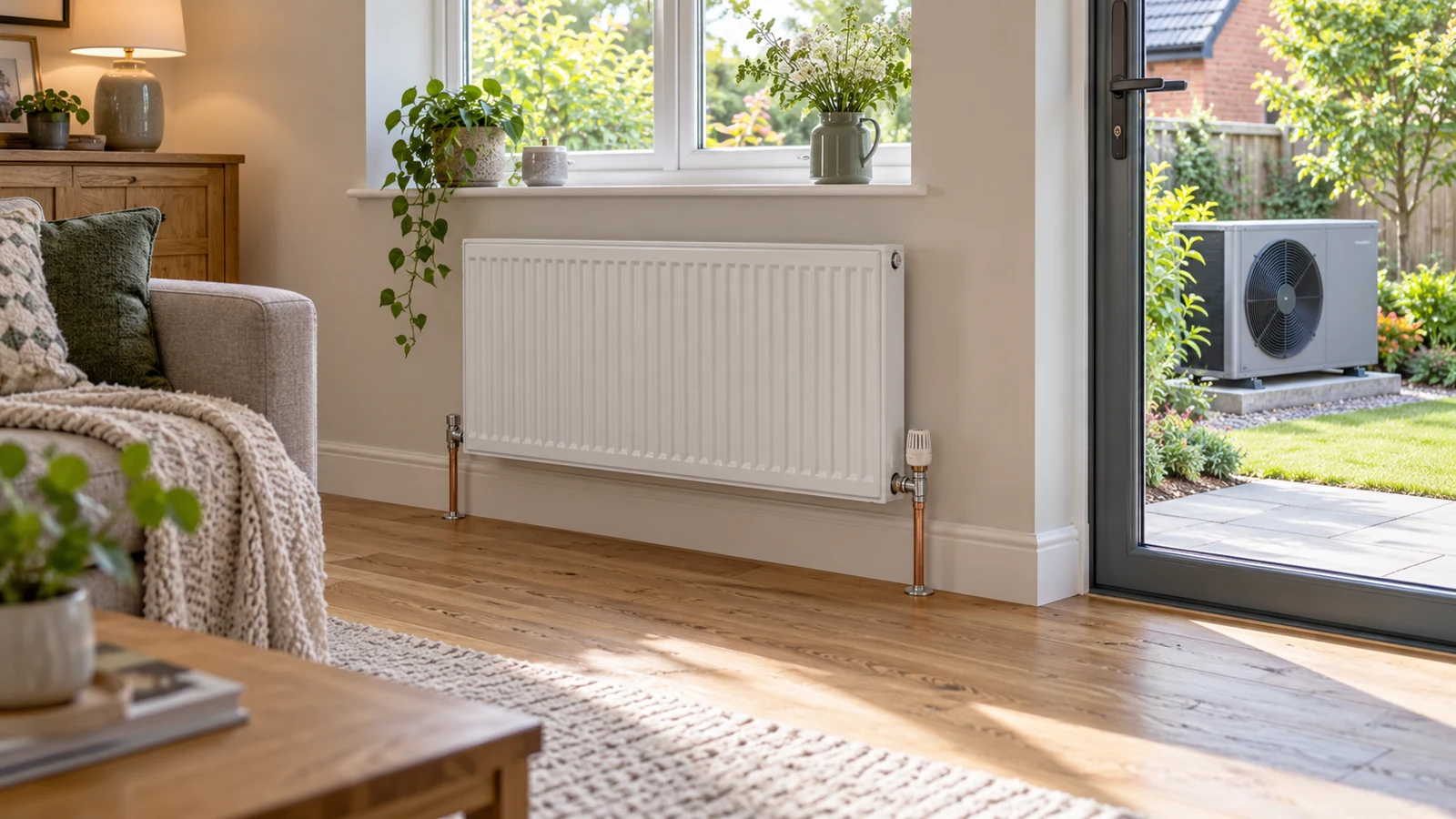
You may be able to use an air-to-water heat pump with existing radiators, but the answer depends on each room’s heat demand and the heat those radiators can deliver at the proposed water temperature. Some homes need only selected upgrades; others need more substantial changes. Ask for a room-by-room assessment before accepting either a promise to keep everything or a recommendation to replace every radiator.
AI-generated illustration of a radiator and outdoor heat pump at a British home.
Why radiator temperature changes the answer
A radiator transfers heat from the water flowing through it into the room. With cooler water, the same radiator gives out less heat. Heat pumps generally work more efficiently when they can provide comfortable rooms using a lower heating-water temperature, so the radiator assessment is part of the system design.
Flow temperature means the temperature of water leaving the heat pump for the heating circuit. It is different from your room thermostat setting. The design also needs a return-water temperature and a target room temperature; all three affect the useful output of a radiator.
There is no single water temperature that every home should use. A proposal should explain the chosen design conditions and how the system will meet the demand in colder weather. The Centre for Sustainable Energy’s heat pump guidance explains the relationship between radiator size, flow temperature and efficiency.
This guide concerns air-to-water systems connected to water-filled radiators. Air-to-air systems heat rooms through indoor air units and do not use the existing radiator circuit.
What the radiator survey should establish
A bedroom count or the output printed on your old boiler does not establish whether individual radiators are suitable. An installer needs to understand both the building and the heating system.
Heat loss for each room
The calculation should reflect room dimensions, walls, windows, roof or floor construction, ventilation, desired indoor temperatures and local winter design conditions. Tell the surveyor about planned insulation, glazing or extensions so the proposal reflects the home you intend to heat.
MCS guidance on understanding heat loss sets out why room-by-room calculations matter. Ask for the results with the proposal, including any assumptions made where construction details were unavailable.
The output of each existing radiator
The survey should record radiator dimensions and construction: for example, the number of panels and rows of convector fins. Two radiators with the same visible height and width can have different outputs. Manufacturer information or an appropriate documented assessment should support the figures used.
A catalogue output is only meaningful alongside its rating conditions. Ask for the expected output at the proposed flow, return and room temperatures, rather than a comparison between your room’s demand and an unadjusted catalogue number.
Pipework, circulation and condition
Radiator capacity is only one part of the assessment. The installer should check whether the pipework and valves can support the required water flow and identify restrictions, corrosion or other condition issues. A radiator that is large enough on paper can still disappoint if water cannot circulate properly.
Record rooms that currently heat slowly or feel cold. Those symptoms are useful clues, although they do not prove that the radiator needs replacing. The cause may involve the controls, circulation, building fabric or more than one issue.
Keep, upgrade or move: compare the options room by room
| Finding | Possible approach | Evidence to request |
|---|---|---|
| Existing radiator meets the room’s demand | Retain it if its condition and connections are suitable | Output at the proposed design temperatures |
| Only a few rooms have a shortfall | Upgrade selected radiators | A room-by-room replacement schedule |
| Limited wall space | Assess a deeper radiator or another suitable emitter | Dimensions, output, clearances and any noise or electrical requirements |
| Insulation work is planned | Coordinate the heating design with the confirmed improvements | Heat-loss assumptions before and after the specified work |
| Keeping radiators requires warmer water | Compare a compatible higher-temperature design with emitter upgrades | Installation scope and annual energy estimates on comparable assumptions |
A deeper double- or triple-panel radiator may provide more output without taking up more wall width, but it projects further into the room. Check doors, furniture, curtains and usable space. A replacement should be selected by its performance at the design conditions, as well as its appearance.
Underfloor heating is another option where the building work suits it, but fitting a heat pump does not automatically mean lifting every floor. Consider disruption, floor build-up and the design of any mixed radiator and underfloor system before choosing it.
Would a high-temperature heat pump avoid replacements?
A compatible higher-temperature heat pump may allow more existing radiators to remain. That does not settle the question by itself. Ask what temperature the particular installation will need and how its expected electricity use compares with an alternative that upgrades selected radiators.
The comparison should use the same home heat demand, indoor temperatures, weather assumptions and electricity tariff. Separate space heating from hot water, and ask how any electric backup heating is accounted for. A product’s maximum possible water temperature is not a prediction of year-round running costs.
Compare the initial work and expected operation together. Keeping an awkward radiator may reduce disruption; replacing a few limiting emitters may allow a different design. The useful answer is a documented choice for your property.
What a comparable installation quote should include
Ask each company to identify retained radiators, replacements and any work still subject to inspection. A clear quote should distinguish the heat pump, cylinder if needed, controls, radiator changes, pipework, electrical work and commissioning.
- Design: room heat losses, proposed heating temperatures and the radiator schedule.
- Replacement details: manufacturer or specification, dimensions, valves and locations.
- Building work: floor access, lifting carpets, pipe boxing, wall repairs and decoration.
- System preparation: cleaning, water treatment and any remedial work appropriate to the design and manufacturer’s requirements.
- Completion: testing, balancing, control settings, handover information and aftercare.
- Commercial terms: the total payable, VAT treatment, exclusions, payment stages and how variations are approved.
Two quotations that retain different numbers of radiators may be based on different design temperatures. Resolve that difference before judging one as better value. Do not assume a lower installation total means lower bills.
If you are still comparing heating options, our guide to the advantages and disadvantages of conventional boilers explains how that type of stored-hot-water arrangement works. It provides background rather than a property-specific recommendation.
How to prepare for a heat pump radiator survey
You need a notebook or phone, any available heating records and a list of planned building improvements. This is information gathering; the heating design and installation need an appropriately competent professional.
- Record the current heating. Note the existing heat source, rooms that are hard to heat and any known faults. Gather recent energy-use records if available.
- List planned improvements. Write down confirmed insulation, glazing or layout changes and when they are expected to happen.
- Photograph the radiators. Take accessible photographs and note approximate dimensions without removing covers, opening appliances or disturbing pipework.
- Request a room-by-room assessment. Ask the installer to provide heat-loss results, design temperatures and a schedule showing which radiators stay or change.
- Compare the written proposals. Check the same scope, performance assumptions, exclusions and making-good work before agreeing a contract.
A lower-temperature boiler trial can sometimes provide useful observations, but mild-weather comfort does not prove winter suitability. Obtain advice for your particular system before changing settings, especially where stored hot water is involved. A trial does not replace the design calculations.
Frequently asked questions
Do all radiators need replacing for a heat pump?
No. Some existing radiators may supply enough heat at the proposed design temperatures. A room-by-room heat-loss and radiator-output assessment should identify which can stay.
Will a heat pump work with small-bore pipework?
It depends on the pipe sizes, layout, required water flow and condition. Ask the installer to assess the circuit rather than promising either complete reuse or a full repipe from pipe diameter alone.
Do radiators have to feel very hot to warm a room?
No. A correctly designed radiator system can maintain comfort with cooler surfaces and longer heating periods. The relevant check is whether each room reaches its intended temperature in the design conditions.
Can I keep a bathroom towel rail?
Possibly, but the installer must check its useful output at the proposed water temperatures against the bathroom’s heat demand. Do not assume a towel rail will provide all the space heating needed.
Does keeping every radiator guarantee a cheaper installation?
No. Other work, equipment choices and system condition affect the total. Compare the complete written scope and expected energy use as well as the radiator replacement allowance.
Find an installer who can explain the design
Start with a survey and a clear radiator schedule. You can enquire with air source heat pump installers through Air Source Heat Pump Cost, a referral website connecting homeowners with independent specialists. Ask the responding business to confirm its relevant certification, insurance and the scope of its assessment.
For broader preparation, the Energy Saving Trust’s air source heat pump guide covers the system and practical considerations. Bring your radiator questions to the survey so the final proposal explains how every room will be heated.